
RCS vs SMS: Which Messaging Tool Fits Your Business Best?
Businesses now have more messaging options than traditional short message service (SMS) alone.
Rich Communication Services (RCS) introduces branded messaging, interactive buttons, richer media, and app-like experiences directly inside supported messaging apps.
At the same time, SMS remains the most dependable option for broad customer communication because it works on nearly every mobile device without internet access or additional setup.
The challenge is understanding where each channel fits best.
In this guide, you’ll learn the differences between SMS and RCS, where multimedia messaging service (MMS) fits between them, and how you can use texting platforms like Textellent to manage messaging campaigns more effectively.
TL;DR
- SMS is still the most dependable option for broad business communication because it works on nearly every mobile phone and does not require internet access.
- RCS adds richer messaging features like branded sender profiles, read receipts, interactive buttons, carousels, and higher-quality media, but availability can vary.
- MMS fills the gap between SMS and RCS by letting you add visual content to text campaigns without building a full RCS setup.
- The best choice depends on your message goal: use SMS for broader reach, MMS for visual updates, and RCS for interactive experiences.
- Textellent helps you run SMS and MMS campaigns with advanced SMS automation, segmentation, media support, and reporting tools.
RCS vs SMS: Quick Comparison
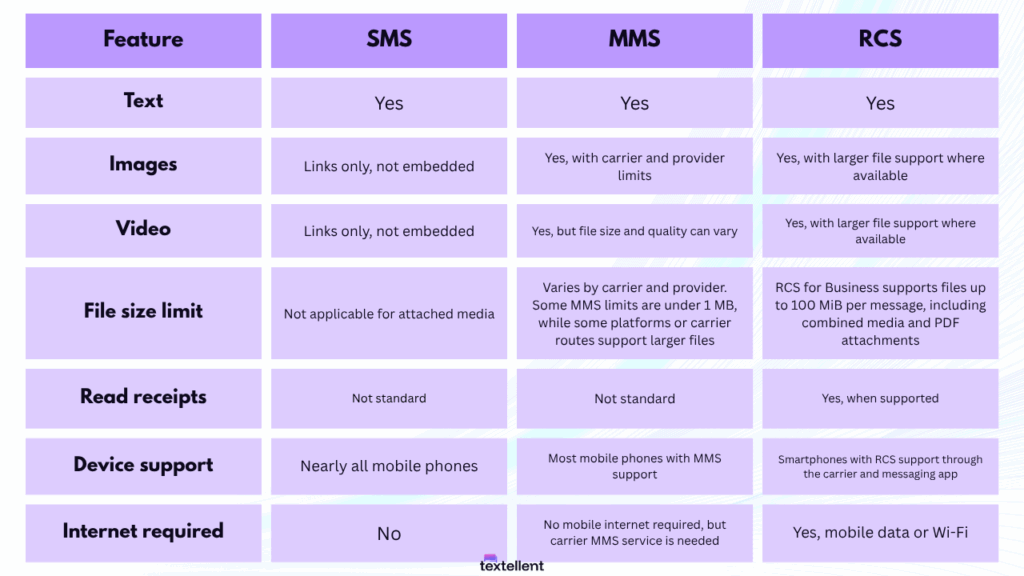
Here’s a quick side-by-side look at how SMS and RCS compare for business messaging.
What Is SMS?
SMS is the original texting technology used to send text-only messages up to 160 characters.
Unlike mobile messaging apps, SMS is universally supported. It doesn’t require any extra apps, which makes it accessible to virtually all mobile devices, including older models.
This is a big reason many businesses still use it for updates, reminders, alerts, and transactional messages. SMS relies on built-in cellular network functions handled by your phone carrier.
Why SMS Still Works for Business Communication
While SMS is often viewed as an older technology, it still remains one of the most reliable communication channels for businesses.
One reason is that SMS works without needing an active internet connection. If your customer has a mobile phone, you can reach them via text message, even when data connectivity is limited.
SMS also makes it easier for customers to receive messages without downloading an app, changing settings, or relying on a data connection.
Platforms like Textellent give you powerful features on top of standard SMS. You can send bulk SMS, segment contact lists, and deliver MMS content alongside plain messages.
This gives your traditional SMS campaigns more visual appeal while keeping the reach that SMS already provides. Sign up for a free trial or book a demo with Textellent today!
What Is RCS?
RCS is a next-generation messaging protocol designed to improve traditional SMS. It’s built directly into the phone’s native messaging app.
It adds modern messaging features like images, video, live buttons, typing indicators, read receipts, and multimedia sharing.
If you and the other person enable RCS, and both networks support it, the message is sent as an RCS chat. If not, the message switches back to SMS.
RCS messaging can support longer messages, branded experiences, and richer media inside supported texting apps.
However, customers still need compatible devices, supported mobile carriers, and working data networks before every RCS feature can appear as expected.
Why RCS Adoption is Slower
In late 2024, Apple confirmed support for RCS, and the update has now rolled out to iPhones in 2025.
Today, iPhone users with iOS 18 and a carrier that supports RCS can send richer messages to Android users and other supported devices. This includes high-resolution photos and videos, links, delivery receipts, read receipts, and typing indicators.
RCS adoption still depends heavily on device compatibility, carrier support, and messaging settings. Some users may not have RCS enabled, while others still use devices or networks with limited support.
Still, even with Apple’s support, RCS hasn’t entirely replaced SMS for several reasons:
- Business messaging with RCS is more complex. You need to register with approved messaging partners, and setup takes longer than traditional SMS platforms.
- Many mobile phone users still view RCS messages the same as SMS. Some don’t recognize the added features or understand when they’re being used.
- RCS can fall back to SMS or MMS. If RCS is unavailable, the message may switch to SMS or MMS so the conversation can continue.
Because of these limits, many businesses still rely on SMS as their main way of reaching customers.
However, RCS is becoming more important for businesses that want richer media and more interactive messaging experiences on both iPhone and Android devices.
How Business Texting Has Grown
Business texting has changed a lot over the past 10 years. What started as a way to send basic alerts has now become a major tool for marketing, customer service, and real-time updates.
People exchanged more than 2.1 trillion SMS and MMS messages in the latest CTIA annual data, which equals more than 67,000 messages every second. That shows how deeply texting is still built into daily mobile communication.
As business needs grew, texting moved beyond one-way updates. Customers began using text threads to confirm appointments, check delivery status, and respond to offers without calling or opening another app.
However, as customer expectations changed, plain text alone became less effective for more visual or interactive communication.
That’s when richer forms of mobile communication started to matter more.
Where MMS Fits Between SMS and RCS
If you’ve been comparing SMS and RCS, MMS gives you another way to send richer text messages without relying on full RCS support.
MMS allows businesses to include images, GIFs, audio, and short videos in campaigns while still maintaining broad compatibility with mobile devices.
That makes it useful when a plain SMS campaign is not enough, but full RCS support is still unavailable for some customers.
MMS also works well for promotions, appointment reminders, product highlights, and branded updates that benefit from stronger visual communication.
When Should You Use SMS and RCS
Each messaging channel works better for different types of customer conversations.
The best choice depends on your message goal, your target audience, and how much visual or interactive content you need.
Use SMS When You Need Broad Reach
SMS is best when your message needs to reach as many people as possible. It works on nearly every mobile device and does not require mobile data, Wi-Fi, or a special messaging app.
Best use cases
- Appointment reminders
- Two-factor authentication (2FA)
- Delivery updates and shipping notifications
- Promotional messages
- Customer service follow-ups
- Review requests
- Verification codes
- Billing notices
SMS is also the better option for urgent or simple messages. If you need to send a quick confirmation, reminder, or alert, SMS messages keep the experience simple for the customer.
Textellent helps you stick with SMS while staying ready to send RCS messages where possible. The platform handles SMS segmentation, message delivery, and reporting, so you don’t need to guess which format to use.
Use RCS When You Need Branded Messaging
RCS is better when your campaign depends on branding, visuals, and interactive elements inside the customer’s default messaging app.
Best use cases
- Branded sender profiles
- Product carousels
- Interactive buttons
- Richer customer support flows
- Visual shopping journeys
- Read receipts and richer engagement data
RCS can create more interactive messaging experiences without requiring customers to download a separate platform.
However, it should not be the only channel for important messages because RCS availability still varies.
Start Reaching More Customers With SMS and Try Textellent
RCS is promising, but SMS and MMS are easy to use and dependable for business messaging.
With Textellent, you don’t have to wait for full RCS support to send modern text campaigns.
The platform allows you to use SMS for reach and MMS for rich media capabilities. You can improve customer engagement, drive more action, and keep your messaging strategy simple as new texting options grow.
Textellent also gives your business tools for segmentation, automation, reporting, and campaign management so that you can run customer messaging from one system.
If you’re ready to move past basic texting and start sending messages your customers see, sign up for a free trial or request a demo consultation with Textellent today!
FAQs About RCS vs SMS
Why does my phone keep switching from RCS to SMS?
Your phone switches from RCS to SMS when RCS cannot deliver the message because of unsupported carriers, weak connections, app issues, or device compatibility limits.
The switch keeps conversations going through SMS or MMS instead. This is one reason text marketing platforms like Textellent still rely on SMS and MMS for dependable business communication.
Which is safer, RCS or SMS?
RCS can offer stronger security features when encryption and verified sender support are available.
However, SMS is still widely used for dependable business communication, especially for reminders, alerts, confirmations, and follow-ups.
Is it better to have RCS on or off?
For most users, it is better to keep RCS on. It adds richer media, read receipts, typing indicators, and better group messaging.
However, RCS uses mobile data or Wi-Fi, so some users may turn it off if they have limited mobile plans or do not have an unlimited data plan.
When running a business, SMS should remain part of your communication plan as it can reach more customers.
How do I switch from RCS to SMS texting?
On Android, open Google Messages, go to Messages settings, then turn off RCS chats or Chat features.
On iPhone, go to Settings > Apps > Messages > RCS Messaging and turn RCS off.
Once disabled or unavailable, conversations will use SMS or MMS instead.

Get Started with Business Texting
Simple to launch, built to scale. Try Textellent FREE for 14 Days
Start Free Trial