
Business SMS & 10DLC
Compliance Hub
Everything your business needs to know to protect your deliverability, build customer trust, and avoid costly carrier penalties.
Compliance is No Longer Optional
As of late 2024, U.S. mobile carriers actively block all text messages sent from unregistered 10-digit numbers. Unregistered business texting is officially dead.
What Is 10DLC?
10DLC (10-digit long code) is a dedicated phone number format created for businesses to send A2P (application-to-person) text messages.
Why 10DLC Was Introduced
Carriers in the United States developed this new system to address increasing concerns about unregistered messages, spam, message deliverability, and regulatory compliance.
Previously, many businesses relied on shared short codes or standard long codes, which were either costly or prone to abuse.
With 10DLC, mobile network operators introduced a structured vetting process to make sure your messaging campaigns are trustworthy and aligned with regulatory standards, such as the Telephone Consumer Protection Act (TCPA) and the Cellular Telecommunications Industry Association (CTIA).
Registration ProcessThe Two-Step 10DLC Registration Checklist
Before sending a single text, businesses must go through a dual-layered vetting process via The Campaign Registry (TCR):
The Regulatory Landscape
You must follow BOTH the Telephone Consumer Protection Act (TCPA) and the Cellular Telecommunications Industry Association (CTIA) to legally text in the United States.
| Governing Body | What It Is | Core Mandate | Consequences of Violation |
|---|---|---|---|
| TCPA & FCC | Federal Law | Legal regulations protecting consumers from unsolicited automated texts. | Heavy monetary lawsuits and statutory legal fines. |
| CTIA & Carriers | Industry Association | Cellular network guidelines optimized for the absolute best user experience. | Blocked campaigns, disabled numbers, and carrier penalties. |
Compliance Checklist for SMS Campaigns
Ensuring your SMS campaigns comply with regulations protects your business and instills trust in your audience.
Text messages can generally be categorized into three types:
SHAFT Content Restrictions
Regardless of whether a user gives you explicit written consent, certain topics are banned from being sent via A2P SMS. Featuring any of this type of content will result in immediate campaign rejection or heavy carrier fines.
Always-On Compliance Monitoring
Industry's First Comprehensive Compliance Monitoring ServiceRegistering a campaign with the carriers is only the first step toward staying compliant. Mobile carriers typically need to see several thousand messages before they can detect a non-compliant pattern, which often means violations go unnoticed until an account is already facing suspension or fines.
To help close that gap, Textellent's monitoring layer runs continuously across the account rather than relying on a single point-in-time approval, watching for SHAFT-related content and other anomalies before they escalate.
Best Practices for Every SMS Campaign
Check these items to ensure your broadcast stays inside carrier guidelines:
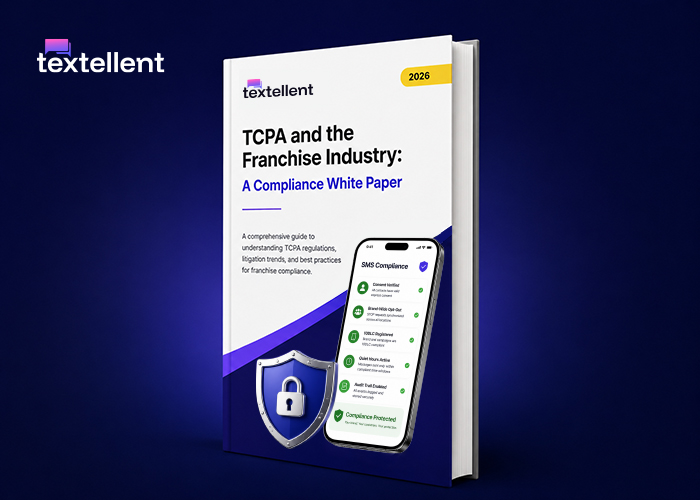
TCPA and the Franchise Industry: A Compliance White Paper
A Compliance White Paper breaking down what the Telephone Consumer Protection Act actually requires for franchise texting from consent standards to real litigation exposure in plain English.
- What counts as prior express consent vs. prior express written consent and why the difference matters
- How courts have applied the TCPA to text messages, with real case law and outcomes
- How uncapped per violation penalties can turn one non-compliant campaign into multi-million dollar exposure
Let Us Handle Your Compliance.
Keeping your SMS marketing compliant can be frustrating and risky. Fines, customer complaints, and blocked messages are all common problems businesses can face.
Textellent makes it easy to stay compliant, protect your deliverability, and keep your communication running without interruption. We will guide you through the 10DLC process and set you up for compliant SMS from day one.