

5 Best SMS Gateway API Providers to Automate Your Messaging
Most businesses already use SMS marketing to reach customers. But doing it manually or through basic tools limits what you can achieve.
An SMS gateway API changes that by allowing your systems to send and receive messages automatically. This makes it possible to automate communication, manage conversations, and integrate messaging into your workflows.
But with numerous providers available, choosing the right SMS API can be challenging. Each platform offers different features, pricing models, and levels of flexibility.
In this article, we will break down the five best SMS gateway API providers, what makes each one stand out, and how to choose the right solution based on your business needs.
TL;DR
Here are five SMS gateway API providers worth considering in 2026:
1. Textellent
2. Twilio
3. Vonage
4. Plivo
5. Sinch
Why Should You Use an SMS Service Provider?
As your business grows, sending messages one at a time becomes impractical, especially when you’re managing hundreds or thousands of contacts.
An SMS API enables a computer or application to send and receive texts over the global telecommunications network.
To make this possible, you need an SMS service provider to automate messages based on triggers or schedules. That means less manual work and more consistent communication.
You also want your messaging to connect with your existing systems. SMS providers integrate with customer relationship management (CRM) systems, marketing platforms, and internal systems, so conversations stay tied to your data.
There’s also the compliance side to consider. Messaging at scale comes with rules, and ignoring them can affect delivery or even block your messages.
An SMS service provider handles opt-ins, opt-outs, and carrier requirements so your messages reach the right people. That level of control helps maintain trust with your audience while keeping your communication reliable.
5 Best SMS Gateway API Providers
Some platforms focus on developers, while others balance API power with business usability. Here are five of the best SMS gateway APIs to consider in 2026.
1. Textellent
Many SMS API providers focus only on message delivery, which leaves you to build automation, campaigns, and workflows on your own.
Textellent takes a more complete approach by combining SMS capabilities with built-in tools for customer communication, marketing, and automation.
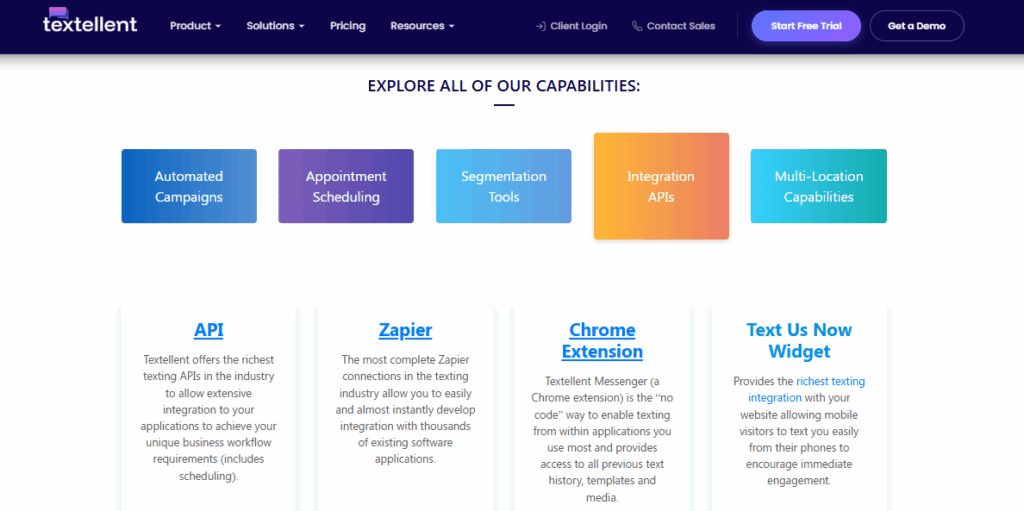
Instead of acting as a developer-only solution, Textellent is designed as a business SMS solution with API access available to extend messaging workflows when needed.
Turn Text Messages Into Real Conversations
Textellent is built around real business use cases such as SMS campaigns, reminders, and ongoing conversations. It supports two-way messaging, scheduled campaigns, bulk SMS, and drip sequences.
Personalization and segmentation features allow you to send SMS messages while maintaining relevance, which can increase conversion rates. This makes it easier to manage communication at scale without losing context.
Scale Messaging Without Sacrificing Delivery or Compliance
Textellent supports messaging through carrier-approved routes and includes features such as reliable delivery tracking and throughput management with low latency.
It’s designed to handle both one-to-one conversations and large messaging campaigns.
The platform also includes built-in SMS compliance tools such as opt-in management and 10DLC registration support, which improve deliverability and reduce risk when sending bulk SMS messages.
Connect Messaging to Your CRM and Workflows
Textellent integrates with major CRMs such as Salesforce, HubSpot, and Zoho, allowing messaging to stay connected to customer data.
API access is included across plans, which allows developers to extend functionality when needed. At the same time, teams can manage messaging through a shared inbox, campaigns, and dashboards without building custom tools.
This combination makes it easier to connect messaging with existing workflows instead of running it as a separate system.
Built for Teams That Need Simplicity and Control
Textellent is designed for ease of use, with onboarding support, templates, and automation tools built into the platform. Teams can launch campaigns, manage replies, and track performance without relying heavily on developers.
The platform also includes features such as appointment reminders, segmentation, and analytics dashboards. It gives you visibility into message performance and customer engagement.
Pay for What You Need Without Complexity
Textellent offers simple monthly pricing that includes SMS credits, automation tools, and marketing features in one plan. It’s easier to manage costs without dealing with complex usage fees.
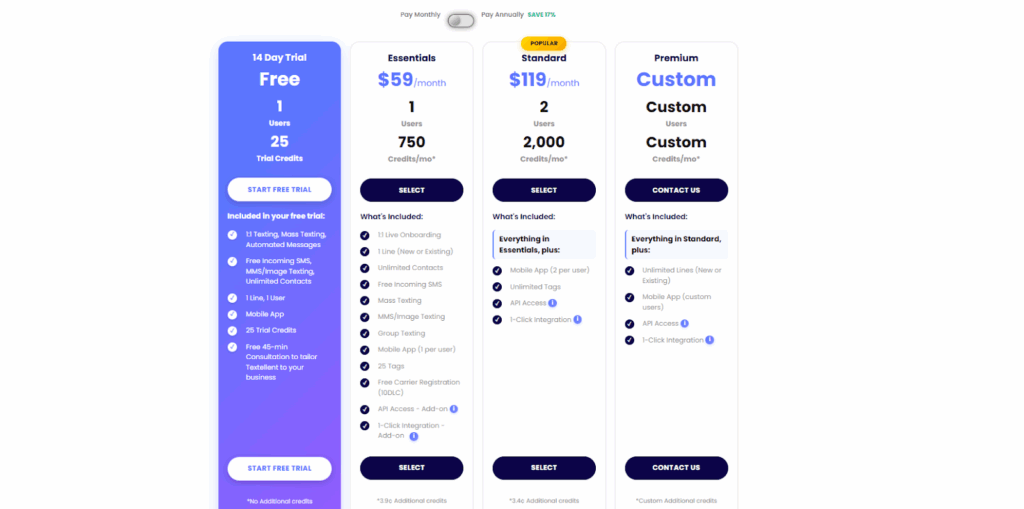
You can begin with a 14-day free trial that includes 25 SMS credits and access for a single user. This allows you to test the platform before making a decision.
The Essentials plan starts at $59 per month and includes 750 SMS credits with one user. It is a good fit for small businesses that want basic automation and campaign features.
The Standard plan starts at $119 per month and includes 2,000 SMS credits with two users. This works well for growing teams that need more message volume and shared access.
For larger businesses, the Premium plan offers custom pricing based on users and message volume.
Textellent also provides industry-specific plans for tax and accounting firms, with features designed to match their workflows.
If you’re looking for an SMS platform that combines messaging, automation, and ease of use, book a demo with Textellent today!
2. Twilio
Twilio is one of the most widely used SMS gateway API providers, known for its developer-first platform and global communication infrastructure. It supports messaging in over 180 countries and extends beyond SMS into voice, video, email, and chat.
Image Source: twilio.com
Core Messaging Capabilities and API Structure
The Programmable Messaging API allows you to send transactional and bulk messages through SMS, MMS, WhatsApp, and Facebook Messenger using a single integration.
It supports outbound and inbound messaging, along with real-time delivery tracking and response handling.
For more advanced use cases, the Conversations API enables ongoing two-way messaging on multiple communication channels. It supports threaded conversations, multiple participants, and message history for customer support and sales communication.
Global Infrastructure and Scalability
Twilio operates on a global network with connections to over 1,500 carriers. It supports high-volume messaging with localized sender options and compliance tools.
Features such as delivery tracking, fallback routing, and traffic optimization improve reliability and performance.
Developer Experience and Integration Flexibility
Twilio provides detailed API documentation, SDKs, and quick-start guides for languages such as Python, Node.js, Java, C#, PHP, and Ruby. Its APIs integrate with CRMs, marketing tools, and custom systems, which makes it a common choice for building messaging into applications.
It also supports webhooks, scheduling, and routing optimization for automating workflows and responding to real-time events.
Support Model and Usability Considerations
Twilio’s support model is mostly self-service. You will rely on documentation, community forums, and ticket-based support unless you upgrade to a paid support plan.
Technical teams can benefit from Twilio, but if you need hands-on onboarding or compliance guidance, such as 10DLC registration, you may find their support limited.
The platform also requires a build-it-yourself approach, with fewer built-in tools for collaboration or campaign management.
Pricing Structure
Twilio uses a pay-as-you-go pricing model based on message usage, destination, and number type.
In the United States, SMS messages start at $0.0083 per message segment for both sending and receiving.
The Conversations API uses a usage-based model starting at $0.05 per active user per month, along with $0.25 per GB for media storage and standard messaging fees on top.
They also offer volume-based discounts if you plan to send high-volume messages.
3. Vonage
Vonage (formerly Nexmo) is a global communications platform that provides an SMS gateway API designed for reliable international messaging. It focuses on carrier connectivity, global delivery, and multi-channel communication.
Image Source: vonage.com
Core Messaging Capabilities and API Structure
Vonage offers a REST-based SMS API that allows you to send and receive text messages using standard HTTP requests. Messages are routed through carrier networks, enabling automated communication from applications.
The platform supports inbound and outbound messaging, delivery receipts, sender ID customization, Unicode messaging, and message concatenation for longer texts.
Global Infrastructure and Scalability
Vonage connects to a large global carrier network to reach users in most countries. It includes Adaptive Routing, which reroutes messages when network issues occur, improving delivery performance.
This software also includes traffic control and queuing tools to manage high message volumes and stay within carrier limits.
Developer Experience and Integration Flexibility
Vonage provides developer documentation, SDKs, and tools for integration into CRMs, internal systems, and customer applications. It supports virtual numbers, local sender IDs, and subaccounts, which help you manage messaging across regions and teams.
Support Model and Usability Considerations
Vonage is designed for flexibility, so most workflows must be built through the API. This works well for developers but can create a learning curve for non-technical teams that prefer ready-to-use tools.
Pricing Structure
Vonage uses a pay-as-you-go pricing model where costs depend on message volume, destination, and carrier fees.
Outbound SMS starts at $0.00809 per message, while inbound messages cost $0.00649 per message.
Additional costs may include, such as carrier surcharges, which can add $0.0025 to $0.005 per message, depending on the network.
Renting a virtual phone number starts at $0.90 per month, while toll-free numbers cost $1.75 per month, and short codes cost $1,000 per month with a three-month minimum.
4. Plivo
Plivo is a cloud communications platform focused on scalable messaging and cost control. It is often used by businesses that send high volumes of messages and want a more affordable SMS gateway API.
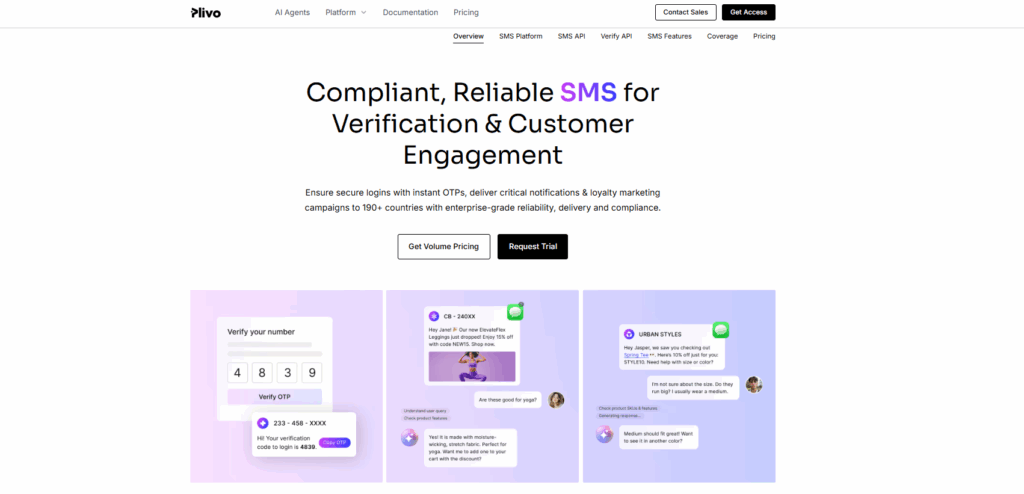
Image Source: plivo.com
Core Messaging Capabilities and API Structure
Plivo provides a REST-based API for sending and receiving SMS and MMS messages. It supports standard HTTP requests with JSON payloads, along with inbound messaging and delivery tracking.
The platform includes features such as message concatenation, Unicode support, and webhooks for handling delivery updates and incoming replies.
Plivo focuses mainly on SMS and voice communication. Its Messaging API supports transactional alerts, authentication messages, and bulk notifications.
Global Infrastructure and Scalability
Plivo supports messaging in more than 190 countries and connects with a wide network of carriers.
The platform offers a high-throughput messaging service, with features such as queuing and routing optimization to maintain delivery performance. This makes it suitable for bulk text messages and large-scale SMS notifications.
Developer Experience and Integration Flexibility
Plivo offers SDKs for multiple languages, including Python, Node.js, Java, PHP, Ruby, and .NET. Its API integrates with your existing software platforms to automate messaging workflows.
However, most features require manual setup, and it does not include built-in tools for collaboration or campaign management.
Support Model and Usability Considerations
Plivo provides documentation and onboarding resources and is often considered easier to set up than more complex platforms. Still, it remains developer-focused, and non-technical teams may need additional support or tools.
Pricing Structure
Plivo uses a pay-as-you-go pricing model based on message usage, destination, and number type.
Outbound and inbound SMS pricing starts around $0.0077 per message, while RCS messages range from $0.00770 to $0.01800 per message.
Additional SMS carrier surcharges are also included, which range between $0.0030 and $0.0050 per message depending on the network.
You can also select the Enterprise plan, which starts at $1,000 per month and covers 190 countries.
5. Sinch
Sinch is an enterprise-level communications platform that offers an SMS gateway API built for global, high-volume messaging. It supports SMS, voice, and verification services for businesses that need reliable infrastructure and strong security.
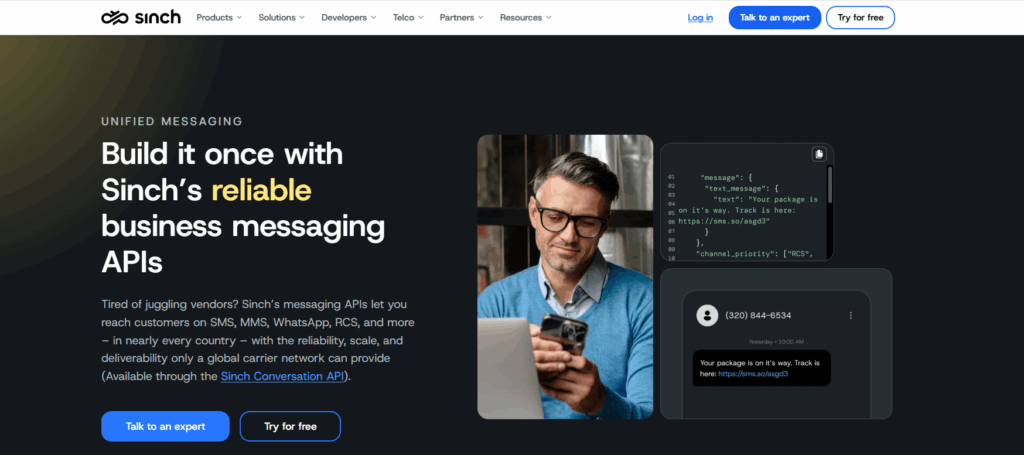
Image Source: sinch.com
Core Messaging Capabilities and API Structure
Sinch provides a REST-based API that allows you to send text messages through a single integration. It supports inbound and outbound messaging, MMS in some regions, and real-time delivery tracking.
The platform includes features such as message batching, detailed delivery reports, and automated responses, which support workflow automation.
Global Infrastructure and Scalability
Sinch connects directly to over 600 carriers, which improves delivery speed and reduces filtering. Its infrastructure supports high-volume messaging and large-scale campaigns.
It also offers high availability, with uptime above 99.9%, along with routing optimization and fraud detection to maintain performance and security.
Developer Experience and Integration Flexibility
Sinch provides SDKs and documentation for integrating messaging into applications and systems. It supports webhooks, scheduling, and reporting tools for automation and tracking.
A self-service portal is also available for managing campaigns without building every feature from scratch.
Support Model and Usability Considerations
Sinch is designed for enterprise use, with account-based support for onboarding, compliance, and routing setup. It includes tools for security and fraud prevention.
The platform can be complex to implement, especially for smaller teams without technical resources.
Pricing Structure
Sinch charges $0.0078 for receiving and sending messages via toll-free and 10DLC numbers. Using a short code would cost you $0.009 for sending and receiving texts.
RCS messaging is priced the same as toll-free and 10DLC numbers. It’s worth noting that carrier fees are applied on top of these prices.
How Do You Evaluate SMS Gateway APIs?
Every platform comes with different strengths. The best choice depends on your use case, team, and budget. Here are the key factors you should evaluate before making a decision.
Choose a Platform That Matches Your Team’s Technical Skills
Some API platforms require heavy development work and ongoing maintenance, which can slow down teams that need to move quickly.
Others offer a more accessible setup with built-in tools that reduce the need for constant engineering support and include code samples for faster setup.
This is where Textellent stands out. Instead of forcing you to choose between a developer-heavy API or a basic messaging tool, Textellent combines both.
You get built-in automation, campaigns, and team features out of the box, while still having API access to extend functionality when needed.
Your support team can start using it right away without building everything from scratch. Developers also have the flexibility to extend functionality using their preferred programming language when needed.
If you want to simplify how your business handles messaging without giving up flexibility, sign up for a free trial or book a demo with Textellent today!
Compare Reliability and Deliverability
A strong SMS gateway API should consistently deliver messages without delays, failures, or filtering.
Well-managed messaging programs can reach delivery rates between 95% and 99%, but performance depends on factors such as carrier connections, sender reputation, and message compliance.
Messages pass through multiple systems before reaching a phone, so issues at any stage can affect delivery.
To maintain consistent performance, look for providers with strong carrier relationships, smart routing, and built-in compliance support such as 10DLC registration.
Fast delivery tracking and real-time reports also give you visibility into message status. You can quickly identify issues and receive messages reliably.
Evaluate Support and Onboarding
Setting up API messaging involves compliance steps, number registration, and SMS integration work that can take time if you are doing it alone.
In some cases, onboarding can take weeks depending on regulations and setup requirements.
A strong provider should offer documentation, guided setup, and access to support when issues come up. Platforms with structured onboarding, sandbox testing, and real-time assistance make it easier to launch faster and avoid delays.
You should also look for ongoing support, not just initial setup. Messaging needs change over time, and having access to help, updates, and troubleshooting ensures your system continues to perform.
Balance Cost With Features
SMS marketing cost should always be evaluated alongside value, especially when planning your next campaign.
A lower-cost provider may lack automation, integrations, or compliance tools, which can create extra work or reduce performance.
On the other hand, paying for advanced features you do not use can increase costs without real benefit.
The best approach is to choose an SMS platform that aligns with how you send messages, so you get the right mix of features, reliability, and cost without unnecessary overhead.
Get API Flexibility Without Developer Overhead With Textellent
If you are considering an SMS gateway API, sending messages is just the starting point. What matters is how those messages drive engagement, build trust, and create a stronger customer experience.
With Textellent, you get powerful messaging capabilities, built-in automation, and flexible integration with your existing systems. This allows your team to send relevant messages while keeping communication easy to manage, without relying on complex development.
If you want a solution that supports better communication and long-term growth, Textellent is worth exploring.

Sign up for a free trial or book a demo with Textellent today to see how it can improve how your business connects with customers through SMS!
FAQs About SMS Gateway API
What types of messages can you send with an SMS gateway API?
An SMS gateway API supports more than basic text messages. You can send transactional messages such as order updates, reminders, verification codes, or promotional messages.
Some providers also support MMS, which allows you to include images, links, or media in your messages.
How fast are messages delivered through an SMS gateway API?
SMS messages are typically delivered within a few seconds. Delivery speed depends on factors such as carrier routing, message volume, and compliance status.
High-quality SMS providers use optimized routing and direct operator connections to maintain consistent delivery even during peak traffic.
Can SMS gateway APIs support two-way conversations?
Yes, many SMS gateway APIs allow customers to reply to messages and continue conversations in real time.
Two-way messaging is useful for sales, customer service, and appointment confirmations where interaction is required.
With the right setup, your SMS API makes it possible to manage conversations within your system or app, keeping communication organized and accessible.
How much does an SMS gateway API cost?
The cost of an SMS API depends on message volume, destination, and number type.
SMS marketing pricing typically ranges from about $0.0045 to $0.01 per message, depending on the provider.
Additional costs may include phone number fees, carrier surcharges, and compliance requirements such as 10DLC registration.
Access is typically managed through a secure API key, and some providers offer sample code to help you get started quickly.

Get Started with Business Texting
Simple to launch, built to scale. Try Textellent FREE for 14 Days
Start Free Trial