

SMS Marketing Pricing Comparison to Stop Overpaying in 2026
What looks affordable at first can quickly become expensive once carrier fees, automation limits, and overage charges are added.
Each SMS provider structures pricing differently. Some focus on per-message rates, others bundle credits into monthly plans, and many layer in registration fees and feature upgrades.
Without a detailed comparison, it’s easy to overlook the full financial impact.
In this article, we’ll explain how SMS pricing works, compare leading texting platforms, and share best practices to lower your SMS marketing costs.
TL;DR
- Four main pricing models are pay-as-you-go, subscription, hybrid, and enterprise, each suited for different business sizes and sending volumes.
- Hidden fees such as A2P registration, number leasing, automation add-ons, and contact storage can increase your total monthly spend.
- To properly compare SMS pricing, you need to calculate your message volume, account for segmentation, include carrier fees, evaluate automation tools, and measure cost per conversion.
- You can lower SMS costs through better targeting, shorter messages, list cleanup, volume negotiation, and by choosing the best SMS platform with predictable pricing.
- Among the five platforms compared below, Textellent stands out with better monthly pricing, built-in automation, transparent credit usage, and industry-specific solutions.
SMS Marketing Pricing Explained
SMS marketing pricing is made up of several cost parts that add up to your actual monthly spend.
The rate you see on a website covers the platform’s cost to send a message, but carriers also charge fees for business messaging.
These carrier fees are passed through by your provider and apply to each SMS or MMS you send. They change by carrier and may vary by number type and destination.
There are also one-time and monthly registration charges tied to SMS compliance tools. Carriers apply per-message surcharges that are separate from your base message price.
Another cost factor is message length. Messages longer than 160 characters get split into multiple segments, and each segment is billed as a separate message.
MMS messages also cost more than standard SMS because they include media content.
SMS Marketing Pricing Models Compared
The best model depends on your message volume, feature needs, and how you plan to reach customers. Here are the most common SMS marketing pricing models.
Pay-as-You-Go Pricing
In the pay-as-you-go model, you only pay for the messages you send. You fund your account, and each message deducts from your balance based on the per-message cost.
This model works well for local businesses, small teams, or companies launching their first SMS campaign. It’s also useful if you want to test how much SMS marketing costs before committing to a larger plan.
The main advantage of this model is flexibility. You’re not locked into a monthly plan.
The downside is that the per-message cost is usually higher, and you get less value for money. You may not have access to advanced tools like two-way messaging, SMS automation, or API access.
Subscription-Based Pricing
When you opt for a subscription-based model, you pay a fixed monthly fee for access to the platform. Most plans include a set number of messages each month.
For example, a plan may include 5,000 messages for a flat monthly price.
If you send more than your limit, you pay an extra charge per message. If you send fewer messages, you still pay the same monthly fee.
The monthly cost covers access to tools such as contact management, basic reporting, and automation features. Higher-tier plans include more advanced tools and higher message limits.
This pricing model is ideal for marketing teams that need to send SMS campaigns every month. It also supports structured customer communication via email marketing and other channels.
Hybrid Pricing
Hybrid pricing models combine a monthly platform fee with a per-message charge. You pay a base subscription cost for access to the software, and you also pay for each message you send.
More advanced platforms also allow you to integrate SMS into your CRM, connect customer data, and build unified customer profiles.
The monthly fee covers platform access, contact storage, reporting tools, and advanced automation features. The per-message charge depends on volume, message length, and carrier fees.
This model is common with most SMS marketing platforms that offer advanced tools or CRM integrations. You get access to strong marketing features, but your exact cost still depends on how many messages you send.
Hybrid pricing is best if you need automation and integration but want flexibility in message volume. However, costs can rise fast if your marketing campaigns grow and message volume increases.
Enterprise Custom Pricing
Custom pricing is designed for large businesses that send high volumes of messages each month. Pricing is not fixed on a public page. Instead, the provider creates a custom quote based on your needs.
If you have to send thousands of messages, you will receive lower per-message rates. However, there is usually a minimum monthly spend.
Enterprise texting plans may include dedicated short codes, account management support, advanced reporting, and custom integrations. Contract terms are also more common at this level.
SMS Marketing Pricing Comparison by Platform
SMS pricing can look similar at first glance, but each provider structures costs in a different way.
Below is a breakdown of popular SMS tools and how their pricing structure compare.
1. Textellent
Textellent is the best SMS marketing platform that combines flexible credit volume, built-in automation, and industry-specific solutions under structured monthly plans.
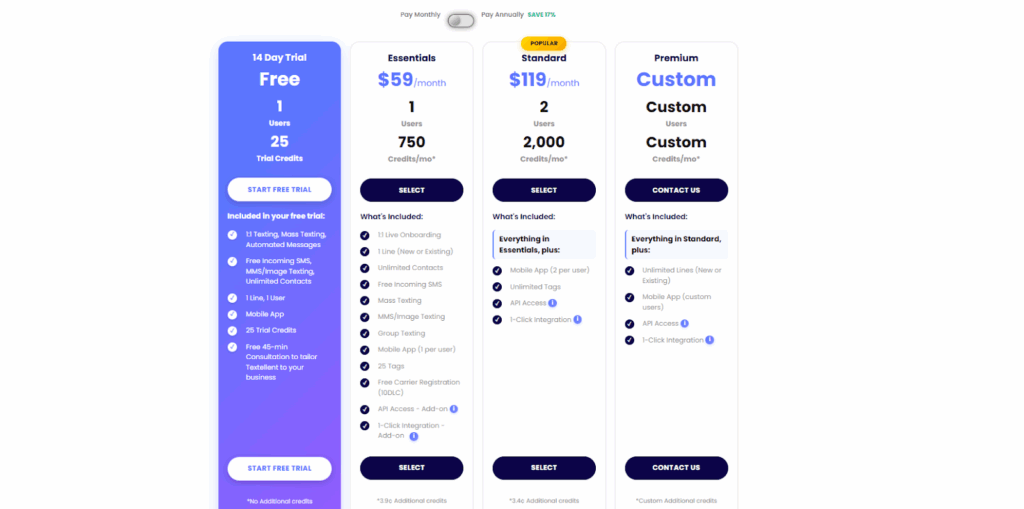
You can start with a 14-day free trial that includes 25 SMS credits and one user, so you can test the platform before committing.
Essentials Plan
The Essentials plan costs $59 per month and includes 750 SMS credits with one user. It is a strong fit for small businesses that want automation tools, templates, and campaign features without a large monthly commitment.
Standard Plan
The Standard plan costs $119 per month and includes 2,000 SMS credits with two users. It is ideal for growing businesses that need more message volume and shared access while keeping predictable monthly pricing.
Premium Plan
The Premium plan offers custom pricing based on your needs. It includes custom user limits and custom credit volume, which works well for higher message volume or more complex campaign needs.
Custom Tax and Accounting Plans
Textellent also offers custom plans built specifically for tax and accounting firms. Pricing depends on the number of offices and clients.
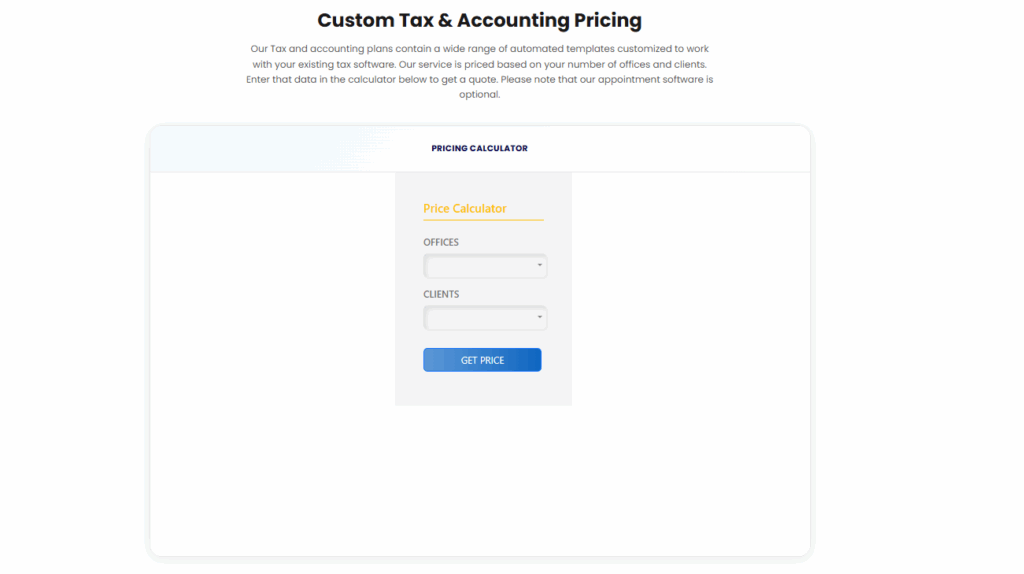
This SMS marketing software also includes automated templates designed to integrate with existing tax software, with appointment software available as an optional add-on.
Sign up for a free trial or book a demo with Textellent and experience structured SMS pricing!
2. EZ Texting
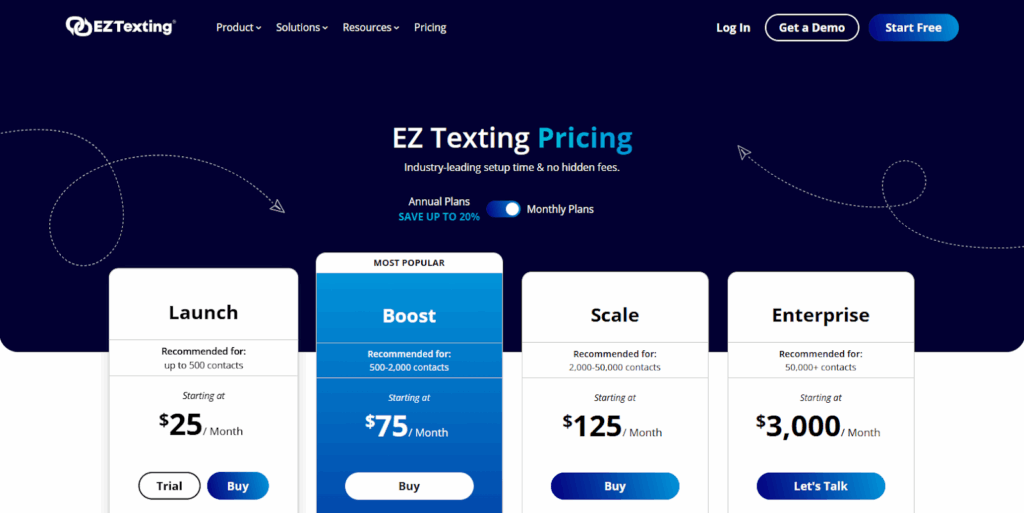
Image Source: eztexting.com
EZ Texting offers tiered pricing plans based on contact size and messaging needs. Each plan includes a set number of monthly credits, with overage charges if you exceed your limit.
Launch Plan
The Launch plan starts at $25 per month and supports up to 500 contacts. It includes 500 monthly credits, one user, a local number, and $0.04 per extra credit plus telecom fees.
Boost Plan
The Boost plan starts at $75 per month and is built for 500 to 2,000 contacts. It includes 500 monthly credits, one user, a high-volume local number, waived telecom fees, and $0.035 per extra credit.
Scale Plan
The Scale plan starts at $125 per month and supports 2,000 to 50,000 contacts. It includes 500 monthly credits, a high-speed local number, waived telecom fees, and $0.03 per extra credit with onboarding support.
Enterprise Plan
The Enterprise plan starts at $3,000 per month and is designed for 50,000 plus contacts. It includes a dedicated short code, 200,000 monthly credits, $0.01 per extra credit, priority support, and a longer setup period.
3. Textedly
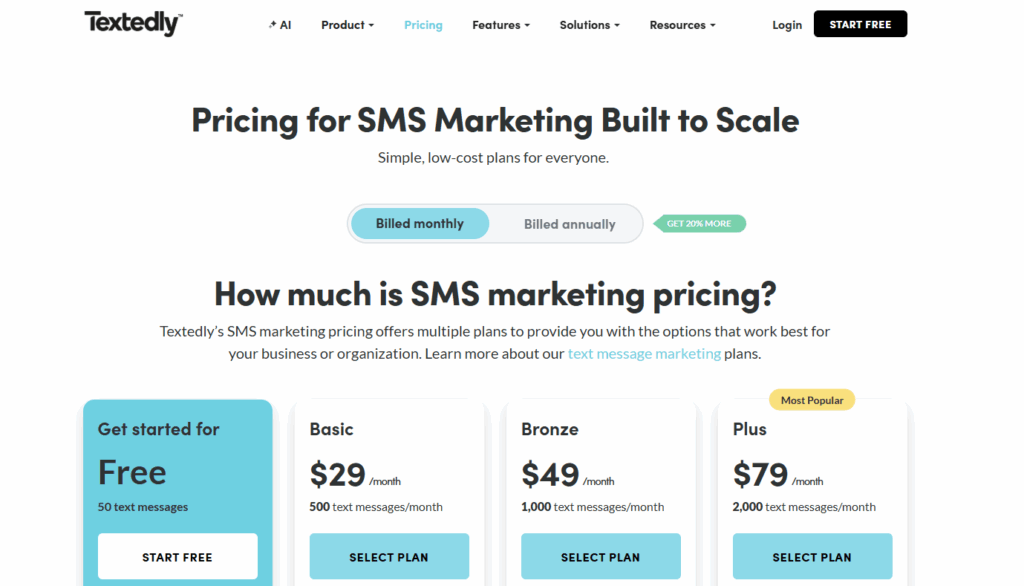
Image Source: textedly.com
Textedly offers several paid plans based on monthly message volume. Each monthly credit plan includes unlimited contacts, free incoming messages, and payment tools.
Free Plan
The free plan includes 50 text messages. You can upgrade to a paid plan to access higher message limits and full features.
Basic Plan
The Basic plan costs $29 per month and includes 500 text messages. It includes one custom keyword, one toll-free number, one 10DLC number, one user seat, and access to support and payment features.
Bronze Plan
The Bronze plan costs $49 per month and includes 1,000 text messages. It offers one custom keyword, one toll-free number, one 10DLC number, one user seat, and full access to messaging tools and support.
Plus Plan
The Plus plan costs $79 per month and includes 2,000 text messages. It includes two custom keywords, one toll-free number, one 10DLC number, one user seat, and the same core features.
Textedly also offers higher-tier plans starting at $125 per month and going up to $5,520 per month for businesses that need to send more than 3,500 messages per month.
These plans are built for higher volume senders and increase monthly message limits based on your needs.
4. TextMagic
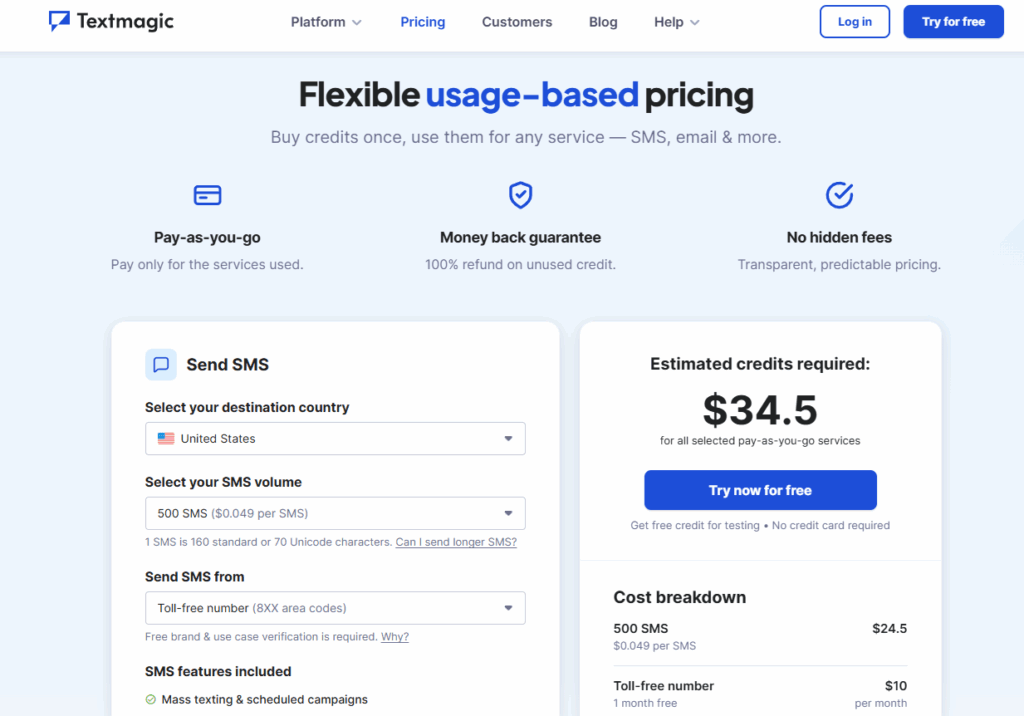
Image Source: textmagic.com
TextMagic uses flexible usage-based pricing. You buy credits and use them for SMS, email, and other services without a required monthly subscription.
For example, sending 500 SMS messages costs $24.50 at $0.049 per message. A toll-free number costs $10 per month after the first free month, and brand and use case verification is free as part of industry requirements.
5. SlickText
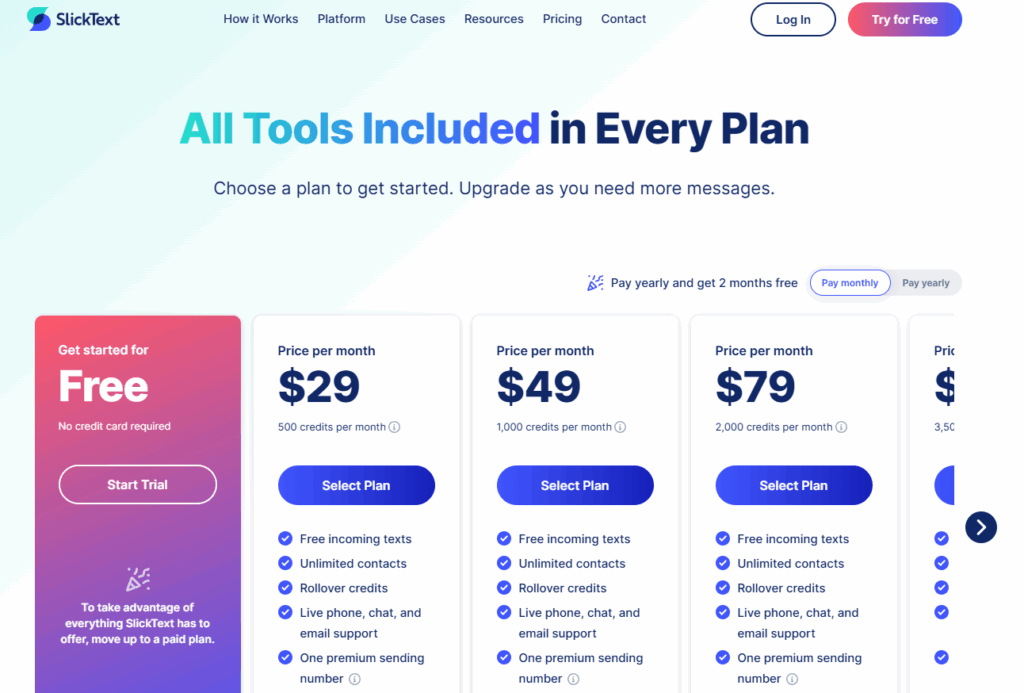
Image Source: slicktext.com
SlickText offers monthly plans based on message credits. Pricing starts at $29 per month for 500 credits and increases based on how many messages you need.
Higher-tier plans go up to $939 per month for 50,000 credits. If you need more than 50,000 messages, their enterprise pricing can be customized based on volume and feature needs.
Hidden Fees in SMS Marketing Pricing
A low per-message rate does not always mean low total cost. Many businesses focus on headline pricing and overlook extra charges that increase monthly spend.
The right SMS platform should account for hidden fees. These costs can change your total budget more than the base message rate.
Here are the most common ones you should review before choosing a provider.
Carrier Surcharges
Carriers charge businesses to send application-to-person (A2P) messages. These surcharges apply on top of your platform’s per-message rate.
The surcharge is usually a small amount per message, but it adds up as volume increases. Some providers show it separately, while others have bundled SMS credits.
Compliance and Registration Fees
In the United States, businesses must register for A2P 10DLC before sending SMS campaigns. There are setup fees and recurring campaign registration charges.
Toll-free numbers also require verification. Short codes have higher approval costs. These compliance expenses are required and sit outside basic platform pricing.
Setup and Onboarding Fees
Some providers charge a one-time setup fee. This may cover account configuration, number provisioning, or training sessions.
Enterprise plans are more likely to include onboarding fees. Smaller self-service platforms may not charge for setup, but you should confirm before signing.
Automation and Workflow Add-ons
Basic plans may not include advanced marketing automation features. You may need to upgrade your plan or pay extra for drip campaigns, triggered messages, or CRM integrations.
If automation is important to your marketing strategy, check if it is included or sold as an add-on.
Contact Storage Fees
Certain platforms limit the number of contacts you can store. If your list grows, you may need to move to a higher pricing tier.
In some cases, there are data storage charges based on contact count. This is common with CRM focused SMS platforms.
Dedicated Number Fees
Sending SMS requires a phone number. Long codes and toll-free numbers come with monthly leasing fees. Short codes cost much more and require higher setup fees.
If you need multiple numbers for different campaigns or locations, your monthly cost increases.
How to Compare SMS Marketing Pricing Models
A proper SMS marketing pricing comparison goes beyond looking at the lowest per-message rate. You need to review your real usage, added fees, and the value each platform delivers.
You can follow these steps to compare pricing the right way.
Step #1: Calculate Your True Message Volume
Start with the total number of contacts your sales team plans to message each month. Then multiply that number by how many campaigns you expect to send.
For example, if you have 3,000 subscribers and send four campaigns per month, that equals 12,000 messages. If you also send appointment reminders or follow-ups, add those to your total.
If you plan to expand into international SMS, factor that volume separately since rates are higher. Your real message count is the base for forecasting cost and measuring future SMS marketing ROI.
Step #2: Factor in Message Segmentation Costs
SMS pricing is based on message segments, not just messages sent. A standard SMS includes up to 160 characters, and anything longer is split into multiple segments.
If your average message is 300 characters, you are paying for two segments per contact. That means 5,000 contacts could equal 10,000 billed segments, not 5,000.
You must check your typical campaign length before comparing providers. Segmentation can double your projected cost if you’re not careful.
Step #3: Include Compliance and Carrier Fees
Business texting includes required registration and carrier charges that sit on top of your platform’s base pricing.
Carriers also apply small surcharges per message. These fees may appear separately on your invoice or be bundled into your per-message rate.
Before choosing an SMS provider, ask for a full breakdown of registration costs, monthly campaign fees, and per message carrier charges.
Step #4: Evaluate Automation Features
Not all SMS plans include automation tools in their base pricing. Some platforms charge extra for drip campaigns, triggered messages, deep CRM integration, or advanced workflows.
If SMS automation drives a large part of your strategy, you can include those feature costs in your total estimate. A slightly higher monthly fee may deliver more value if automation is already built in.
Step #5: Calculate Cost per Conversion
Aside from cost per message, you also need to measure how much you spend to generate a lead or sale.
Start by adding your full monthly SMS cost, including platform fees, message charges, and carrier fees. Then divide that number by the total number of conversions your campaigns produced.
For example, if your monthly spend is $400 and you generate 40 sales, your cost per conversion is $10. Cost per conversion gives you a stronger view of performance than message price alone.
Best Practices to Lower Your SMS Marketing Costs
Lowering your SMS spend does not mean cutting back on results. You only need to control waste and maximize the return from every message sent.
These are practical ways to lower your total SMS marketing cost.
Improve Message Targeting
Bulk texting your entire contact list increases spend without improving results.
A smarter approach is to segment your audience based on data such as past purchases, service history, location, engagement level, or signup source.
You can send promotional messages only to contacts who clicked similar campaigns before. Strong targeting also improves inbound SMS replies because the message is more relevant to the recipient.
Optimize Message Length
Longer messages increase your total cost because they are billed in parts. Even small increases in character count can raise your monthly spend if you send large campaigns.
You need to focus on writing tight, focused copy. Lead with the main offer, include a short call to action, and move extra details to a landing page link.
For example, trimming a message from 290 characters to under 160 characters can cut your message cost nearly in half for the same audience size.
Clean Your Contact List
Every message sent to someone who never opens or clicks still counts toward your monthly spend.
It’s important to review your list on a regular basis and remove contacts who have not engaged in several months. Suppress numbers that repeatedly fail delivery or show no activity, and focus your campaigns on subscribers who interact with your content.
Negotiate Volume Discounts
As your message volume grows, your pricing should improve. Many SMS providers offer lower per-message rates at higher tiers, but you may need to request custom pricing.
If you consistently send large campaigns, ask about bulk discounts or custom contracts. Check your average monthly volume and projected growth before speaking with sales.
Structured negotiation can help you save money and avoid a steep learning curve that comes from switching platforms later due to pricing limitations.
Experience Textellent’s Pricing That’s Built for Business Stability
Choosing SMS software based on price alone can cost you more in the long run. You have to test the platform yourself and choose a solution built for long-term growth, not just short-term savings.
Textellent offers structured monthly plans that combine message credits, smart templates, and automation tools under one clear pricing model.
You get transparent pricing, strong workflow features, and industry-specific options such as tax and accounting automation, all backed by scalable plans that grow with your business.

Sign up for a free trial or book a demo with Textellent and see how it balances pricing, performance, and flexibility!
FAQs About SMS Marketing Pricing Comparison
How much does SMS marketing cost?
It depends on your message volume, features, and the provider you choose. Most providers in the SMS marketing space charge about $0.01 to $0.05 per SMS sent in the United States.
If you require automation, integrations, or higher sending limits, your monthly cost will also increase. Enterprise-level accounts that send large volumes use custom pricing based on usage and support needs.
Are there free SMS marketing platforms?
Some platforms offer free trials or limited free plans. These usually include a small number of test messages but do not support full-scale campaigns.
Free options are useful for testing the software. Long-term business use requires a paid plan due to carrier fees and compliance requirements.
How does MMS pricing compare to SMS?
MMS messages cost more than standard SMS because they include images or media files. The per message rate is higher, and carrier surcharges can also increase.
If your campaigns rely on images, include MMS pricing in your pricing comparison. You can also combine SMS with landing pages or web push notifications to control message length while keeping engagement high.
What is the cheapest SMS marketing service?
A pay-as-you-go provider may cost less for low-volume sending. While subscription plans can lower your cost per message at higher volumes.
To find the best value in the growing SMS space, you may calculate your full monthly cost under each plan. Include subscription fees, carrier charges, number costs, and any add-on tools before deciding.
Textellent offers a free trial so you can test workflows, automation, and reporting before committing. Long-term business texting still requires a paid plan due to carrier fees and registration requirements.

Get Started with Business Texting
Simple to launch, built to scale. Try Textellent FREE for 14 Days
Start Free Trial