

How to Maximize Customer Reach With SMS Business Marketing
Texting customers is easy, but using it to drive real business results takes more than just sending messages.
You might get high open rates, but those numbers don’t always translate into conversions or long-term results. To make business text message marketing work, you need structure, timing, and a reason behind every campaign.
In this article, we’ll show you how to build a smarter SMS marketing strategy that’s built for business results, not just message delivery. We’ll also introduce an SMS marketing software solution with features that help turn simple texts into measurable sales results.
TL;DR
- Texting works because it’s personal and immediate, but real results come from understanding how customers think and why they respond.
- You can build revenue-focused SMS flows by aligning messages with customer lifecycle stages, real-time behavior, and measurable sales moments.
- Different SMS campaigns serve different purposes, including promotions, reminders, onboarding flows, and feedback requests.
- Execution matters just as much as content. Mistakes like sending without consent or ignoring timing can reduce trust and lower performance.
- Textellent gives you the structure to do text marketing right with features that support SMS automation, lifecycle messaging, response tracking, and list growth.
The Psychology of Texting: Why Customers Respond
Unlike email marketing or social media, text message marketing is tied to conversation and quick updates. It reaches mobile phones without distractions from email inboxes or algorithm-driven feeds, which makes it easier to reach customers directly.
Recent data shows that 86% of consumers now opt in for SMS text messages, marking a 20% increase since 2021. This number reflects how many people have grown comfortable with receiving messages from brands they trust.
SMS campaigns that mirror human conversation with a simple structure and direct requests tend to perform better than texts that read like a polished advertisement.
Tone also matters because it signals intent, and texting feels like a conversation when it reflects what the customer already cares about.
As more buyers expect real-time updates, offers, or order info via SMS, the opportunity has become too valuable to ignore. Whether you’re running an online store or service-based business, you need to structure campaigns around how people engage.
Now is the time to assess how text marketing fits into your growth plans. Review your touchpoints, look at where communication breaks down, and test simple message flows that make it easier for potential customers to say “yes.”
Sign up for a free trial or request a demo consultation with Textellent to see how you can turn SMS into your most responsive marketing channel!
Types of SMS Marketing Campaigns
Different types of SMS campaigns serve different goals for small businesses or large enterprises. Here are the main types that drive consistent results across industries.
Promotional Campaigns
Promotional messages are designed to generate immediate action, such as a purchase, sign-up, or response to an offer.
They’re often tied to sales events, product launches, or limited-time deals. They should also focus on urgency and a direct call to action.
Examples
- “Jamie, your VIP deal ends at midnight — 30% off just for you: [link]”
- “New arrivals just landed in your size, Nicole. Tap here for early access.”
- “You left something behind, Dan — your 20% promo code expires in 2 hours: [link].”
Transactional Texts
These are not promotional, but they carry important information related to a customer’s action or account.
Though typically automated, they have some of the highest open and response rates due to their relevance. They’re ideal for SMS payment links, confirmations, or delivery updates.
Examples
- “Hey Rachel, your order #7421 just shipped! Track it here: [link]”
- “Mark, your payment of $79.20 has been received. Thanks for shopping with us.”
- “Hi Carlos, your table is set for 2 tonight at 7:00 PM. We’ll see you then!”
Drip Campaigns / Scheduled Sequences
Drip campaigns are pre-scheduled text flows that guide a contact through a specific process, like onboarding, follow-ups, reminders, or lead nurturing. These work best when paired with behavioral triggers such as time delays, clicks, or replies.
Examples
- “Welcome aboard, Amanda! Let’s get you started — here’s what’s next: [link].”
- “Still weighing it, Eli? Here’s 15% off your first order: WELCOME15”
- “It’s been a while, Jordan — want help getting back on track? We’re here.”
Event or Appointment Reminders
These reduce no-shows and improve attendance by sending well-timed nudges. Messages should include the exact time, date, and any preparation instructions. They’re useful for recurring bookings, upcoming events, or service confirmations.
Examples
- “Hey Maya, your cleaning is booked for 2:15 PM tomorrow. Text C to confirm.”
- “Just a heads up, Evan — your 5 PM booking at Lakeview Studio is still locked in.”
- “Riley, the event starts in 1 hour. Doors open at 6 PM — bring your check-in code.”
Feedback and Survey Requests
After a service is completed or a product is delivered, an SMS review request can be used to gather customer feedback. Keeping the ask short and mobile-friendly increases response.
Examples
- “Taylor, we’d love your thoughts. Rate your visit in 10 seconds: [link.].”
- “Thanks for coming in, Chris. Quick survey: How did we do? [link]”
- “Hi Aisha — your feedback helps us improve. Drop a review here: [lin.k]”
Loyalty Program Updates
Loyalty campaigns keep repeat customers engaged by notifying them of points, rewards, or exclusive benefits. These campaigns are a strong tool to increase sales without pushing constant promotions.
Examples
- “Samantha, you’ve earned a $10 reward. Redeem before Sunday: [link].”
- “You’re just 20 points away from a $25 voucher, Drew — want a bonus boost?”
- “VIP heads-up, Jordan: 2x points this weekend just for members like you.”
Internal Alerts and Operational Messaging
Not all SMS campaigns are customer-facing. Internal alerts help teams stay on track with reminders, deadline nudges, or system notifications, which are useful for field teams or remote operations.
Examples
- “Reminder for David: Dispatch training starts at 8 AM sharp. Reply YES to confirm.”
- “Alex, new work order assigned — 4827 Oak Dr. Check your app for notes.”
- “Tina, system alert posted on your dashboard. Please review before the shift ends.”
How to Structure SMS Into Revenue-Centric Campaigns
The most successful businesses don’t send more messages but rather smarter ones, built around a revenue-focused flow. Each campaign should match the buyer’s intent, connect with timing that reflects real behavior, and link directly to measurable outcomes.
1. Align SMS With the Customer Lifecycle
Rather than treating every contact like a buyer, lifecycle-based messaging meets people where they are.
- Acquisition: This is focused on new leads who haven’t converted yet. These messages should deliver clear, time-sensitive value.
- Onboarding: It helps turn new customers into active users or buyers. SMS can provide setup links, reminders, or helpful prompts.
- Engagement: This is where you might often over-message. You need to implement timing, better context, and personalization based on past activity.
- Re-engagement: This is aimed at people who haven’t interacted in a while. These can include incentives, reminders, or product updates.
Each stage of the customer lifecycle gives you a different reason to reach out. When structured correctly, this approach improves your response rates because messages are tied to intent.
2. Tie Messages to Revenue Moments
Many businesses default to calendar-based sends, such as Friday promos, holiday sales, and end-of-month pushes. While these can work, they don’t always align with when individual customers are ready to act.
The strongest revenue results come when business SMS is tied to customer-driven events. These triggers include:
- Viewed a product but didn’t buy
- Added items to the cart, but didn’t check out
- Browsed services after getting a quote
- Dropped off during onboarding
- Booked once, but didn’t return after 30 days
Instead of running mass texts weekly, you can maintain steady conversions with fewer messages by focusing on high-intent actions. It’s smarter for the budget and long-term customer retention.
3. Segment by Behavior
Demographics might tell you who the person is. But behavior shows where they are in their decision process.
A customer who has opened three messages in the past week is more engaged than one who hasn’t clicked anything in a month, even if they both fall into the same age range or location.
Behavioral segmentation can be based on:
- Last purchase date or visit
- Product categories browsed
- Last response to a campaign
- Time since last interaction
- Cart or form abandonment
These signals create meaningful groups that reflect readiness, interest, or drop-off that can help you deliver the right message.
To use behavioral targeting well, your SMS platform needs access to customer activity, either through native integrations with your CRM, ecommerce system, or tracking tools. The best tools will let you build rules based on actions and trigger messages automatically after a behavior.
4. Use Message Sequences
Most revenue doesn’t come from a single message. It comes from a series of SMS messages designed to move the customer step-by-step toward an action.
People need reminders, follow-ups, and context, but not all at once. Message sequences provide a steady, non-intrusive way to guide action while giving you clear points to track and improve performance.
Here’s a simple example of a three-message sequence when you need to send abandoned cart reminders:
- 1 hour after cart: “Hey Alex, your cart’s still open. Need help finishing up? [link]”
- 24 hours later: “We saved your picks, and here’s 10% off to make it easier: SAVE10”
- 48 hours later: “Last call — we can only hold your items until 9 PM tonight.”
Each message moves the contact forward without repeating the same message. This pacing lets customers make decisions on their terms, but with support along the way.
5. Attach SMS to Sales KPIs
Sales-focused messaging should connect directly to metrics like purchases, bookings, and customer lifetime value. Without this connection, your sales messages may look active but deliver little real return.
The most useful metric to start with is conversion rate per campaign. This shows how many recipients took the desired action after receiving a text.
Another key metric is revenue per message sent. This tells you how much return you’re getting from each send, across different types of campaigns. For example, re-engagement flows may bring in fewer sales but at a higher average order value.
Time is also important. You need to track the time it takes a lead to convert after receiving their first SMS. Over time, you should also compare the lifetime value of customers who engage by SMS to those who don’t.
The best way to manage all of this is to bring SMS performance into your existing sales dashboards. Even message-to-purchase timelines or average order value by campaign can help you see which messages are doing more than just getting opened.
Common SMS Business Marketing Mistakes to Avoid
Even when you have the right marketing tools and a strong SMS subscriber list, small missteps in execution can lead to poor results, rising opt-outs, or missed revenue. Avoiding the errors below helps you protect your deliverability and get stronger returns over time.
Sending Without Consent
Texting people without their permission can expose your business to legal and financial risk. Your messages may be flagged as spam, blocked by carriers, or lead to fines.
Many businesses make the mistake of assuming that collecting a phone number implies permission to send text messages.
But you must state what type of messages the person will receive and provide an easy SMS opt-in method. This could be a checkbox on a form, a text-to-join feature, or a written agreement at the point of contact.
Customers are much more likely to respond when they know why they’re being contacted. Consent-based SMS list entries also tend to perform better over time. Always keep a record of opt-ins, and never purchase contact lists or use scraped phone numbers.
Over-Messaging and Fatigue
This usually happens when you run overlapping campaigns, forget to pause after a recent send, or rely on calendar-based messaging without checking engagement history.
Sending too many messages in a short window is one of the quickest ways to trigger opt-outs, especially when sent to new subscribers.
The same message can perform differently depending on when it’s sent. You need to know the best timing for your marketing messages.
Across industries, certain windows consistently outperform others. Morning (8:00 AM to 12:00 PM) and evening (5:00 PM to 9:00 PM) are high-response periods during weekdays.
Messages sent before 8:00 AM or after 9:00 PM often go ignored and also violate the Telephone Consumer Protection Act (TCPA) guidelines.
But timing should also reflect customer habits. If a segment has a history of responding in the evening, you have to match that pattern.
For service businesses, event reminders work better when sent the day before and two hours prior. For retail, sending just before payday or holidays can raise your response rate without increasing message volume.
Lack of Personalization
When customers receive texts that ignore their behavior, preferences, or history, the message feels like a broadcast and gets ignored.
For example, sending a “come back” offer to someone who just made a purchase two days ago signals that the message didn’t reflect their recent actions.
Strong personalization shows up in small details: a reference to the item they browsed, a time slot they prefer, or the business location nearest to them.
If someone regularly shops on weekends, sending them an offer on a Friday afternoon makes more sense than a Tuesday morning blast.
Poor Timing or Irrelevant Offers
A discount that doesn’t apply to what the customer wants will do the same. These mistakes are common when businesses send the same message to everyone, without considering recent behavior or context.
For example, sending a last-minute promotion at 11 PM is likely to frustrate the recipient. So is offering 15% off a product they’ve already bought.
To avoid this, you need to track customer activity closely and send messages when they are most likely to act. That might mean early evening for working professionals, or just after browsing for a specific service.
Ignoring Analytics and Feedback
If you’re only looking at delivery and open rates, you’re missing what people did after receiving your message. A feedback loop helps you improve performance or catch signs of fatigue before it affects revenue.
You have to track response rates, clicks, opt-outs, and conversions tied to specific messages and sequences. Look for drop-off points and identify which messages consistently lead to action. Over time, these insights guide better timing and stronger offers.
Having a user-friendly dashboard and intuitive user interface can make a major difference here. The right SMS automation tools allow you to monitor results in real time, save time, and make decisions based on real behavior.
How Textellent Helps You Convert More With Text Messaging
Textellent goes beyond standard SMS marketing platforms by offering a feature-rich system built specifically for business marketing. Whether you’re in business-to-business or consumer markets, it’s designed to deliver messages that drive results, not just reach inboxes.
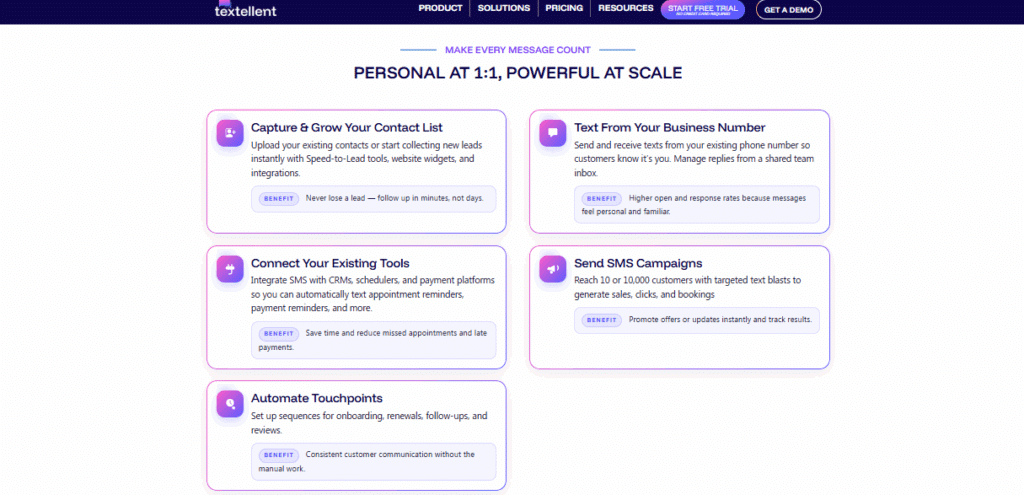
One of its most valuable features is appointment-based texting with full calendar integration. You can send reminders, confirmations, and follow-ups tied to booked time slots. This keeps your staff focused on high-value tasks and reduces the need for phone calls.
Textellent also supports SMS scheduling with segmentation filters. You can schedule messages and target contacts, then set up drip sequences that automatically send follow-ups. These can be timed over days or weeks to help you stay top of mind without overloading loyal customers.
Another standout is its shared inbox and smart routing. Teams can handle replies in a centralized space, which enables one-on-one conversations and responsive support.
Textellent also includes opt-in workflows with built-in compliance, helping you collect phone numbers while meeting TCPA requirements. Opt-outs are automatically processed, and delivery tracking lets you monitor success in real time.
Turn Unorganized Texting Into Structured Revenue—Try Textellent!
If your current SMS marketing service is disconnected or hard to scale, it’s time to switch to a cost-effective marketing strategy and high-performing SMS service.
Textellent is built to help you automate follow-ups, personalize messages, and manage conversations that lead to real sales.
With powerful tools like drip scheduling, response-based routing, contact tagging, and calendar-based reminders, Textellent lets you create structured flows that boost your marketing efforts.
Textellent allows you to communicate directly using a local number, which improves response rates and makes the experience more familiar. You can track message performance, segment contacts by behavior, and trigger offers based on real-time customer actions.
If you’re serious about using SMS as a high-return communication channel, it’s time to use a text messaging service made for business impact.
Sign up for a free trial or request a demo consultation with Textellent and turn texting into a business advantage!
FAQs About SMS Business Marketing
What should I look for in an SMS marketing platform?
A strong platform should go beyond just sending messages. Look for features that support two-way communication, SMS automation, and integration with your existing tools.
While platforms like EZ Texting and Constant Contact offer simple solutions, Textellent is designed to support full-funnel SMS strategies. It includes automation, segmentation, and scheduling to help you send campaigns and customer follow-ups.
How do I handle responses outside of business hours?
You can use SMS autoresponders to acknowledge messages received after hours. For example: “Thanks for your message — we’ll reply during business hours (Mon–Fri, 9 am–5 pm).” This keeps customers informed and shows that their message wasn’t ignored.
Using a texting service with scheduled replies can help maintain customer engagement without requiring your team to be always available.
Should I include images or multimedia in SMS marketing?
Standard SMS only supports plain text. If you want to send images, videos, or audio, you’ll need to use a multimedia messaging service (MMS).
MMS can be effective when used selectively, such as sending product photos, visual promotions, event flyers, or branded graphics. However, keep in mind that MMS comes with higher data rates, and some devices may not support them well. Always test before you hit send.
Is SMS marketing cost-effective for small businesses?
SMS can be a cost-effective way to reach your audience. With the right tools, you can drive sales through quick updates, reminders, and two-way conversations that support faster decision-making.
Plus, it’s a low-cost channel compared to other forms of advertising, and many businesses often get paid faster due to shorter lead-to-sale cycles.

Get Started with Business Texting
Simple to launch, built to scale. Try Textellent FREE for 14 Days
Start Free Trial