

What Features to Look for in Top SMS Marketing Platforms
Between confusing pricing models, limited integrations, and complicated campaign management, it’s easy to get stuck with the wrong setup.
Text message marketing works best when it’s personal and easy to manage. But getting that right means having the right tools in place.
Some platforms are built for large-scale campaigns with smart automations, while others are made for direct team-to-customer communication. You need tools that fit your team’s daily workflow and help you stay consistent with your brand voice.
In this guide, we’ll break down what features you can find in top SMS marketing platforms and how the best tool can support your long-term customer communication strategy.
TL;DR
- Top SMS marketing platforms should offer automation, segmentation, two-way messaging, personalization, compliance handling, and real-time performance tracking.
- Choosing the right platform starts with defining your use cases, evaluating usability, matching messages to customer touchpoints, and looking beyond basic integrations and vague pricing.
- Textellent brings together powerful SMS capabilities in a platform that’s easy to manage, built for real teams, and structured to grow with your business.
Features You Should Look for in SMS Marketing Platforms
The right SMS capabilities make a big difference in how smoothly your communication runs and how much value you get from your investment.
Campaign Automation
SMS automation allows you to schedule and send marketing messages based on timing, actions, or specific triggers without manual follow-up.
You can build messaging flows that respond to customer behavior, such as appointment confirmations, missed responses, or purchases.
The most capable text marketing platform supports event-based messaging, recurring reminders, and time-delayed sequences. These tools help you maintain contact throughout the customer lifecycle.
Audience Segmentation and Targeting
Not every customer or lead is at the same stage or interested in the same product, which makes one-size-fits-all messaging ineffective.
When a text message marketing platform offers SMS segmentation tools, it becomes much easier to create relevant campaigns for each individual.
Advanced segmentation lets you organize your contacts into specific groups based on behavior, demographics, preferences, past interactions, or other custom attributes.
Targeting also helps improve response rates while reducing opt-outs. People are far more likely to engage with a personalized message than one that seems repetitive.
Two‑Way Messaging and Conversation Tools
Two-way SMS transforms texts from a one-directional broadcast into a real conversation channel. It allows customers to reply to your text message campaigns and get real-time responses.
This capability is essential for service coordination, lead follow-up, and customer support. Instead of routing questions through email or phone calls, teams can handle interactions in a single thread.
The best platform offers a centralized inbox where all responses are visible and easy to manage. You can assign replies to team members, track message history, and keep the conversation going without switching tools.
Personalization Options
Personalization turns basic SMS messages into meaningful interactions. Details like a contact’s name, appointment time, service type, or location make your messages feel less like mass texts.
A good SMS platform supports dynamic fields that pull contact-specific data into each message. You can create one template, and the system adjusts it automatically for each recipient based on their profile or activity.
Compliance and Opt‑In Management
Every SMS campaign must follow strict rules to protect both your business and your audience. SMS compliance is essential to avoid fines, message delivery issues, and customer complaints.
A strong texting platform should handle SMS opt-ins and opt-outs automatically. This includes confirming consent before sending targeted messages, recording when and how someone subscribed. You may also provide an easy way for contacts to unsubscribe at any time.
SMS marketing frequency limits and built-in filtering tools are also important. They prevent unwanted messaging at inappropriate times and help preserve trust with your audience.
Performance Tracking and Reporting
Tracking performance is key to understanding what’s working and where to improve. The best SMS marketing software should give you visibility into how your SMS marketing campaigns perform.
Essential SMS marketing metrics include delivery rates, response rates, and link clicks. These show whether messages are reaching your audience and how people are engaging with them.
Some platforms also offer detailed reporting on opt-outs, timing effectiveness, and conversion trends over time.
Integration With Existing Tools
An SMS marketing platform works best when it fits naturally into the systems you already use. Integration with tools like your calendar, helpdesk, or email marketing platform allows you to manage communication without constant switching or duplicate data entry.
When contact records, appointment details, or purchase history flow directly into your SMS platform, your messages become more timely and relevant.
You can pull in customer data for personalization, trigger texts based on activity in other marketing tools, and keep all interactions aligned across teams.
Scalability and Support
As your business grows, your SMS marketing solution needs to grow with it. Scalability helps you support more users, manage larger contact lists, and run more complex campaigns.
A platform built for scale should handle increases in traffic without delivery issues. It should also offer tools to manage multiple users, departments, or locations.
Support matters just as much. When something goes wrong or when advanced features roll out, reliable customer service helps your team stay on track.
Access to onboarding resources, live support, and ongoing updates ensures your platform stays aligned with your changing goals.
How to Choose the Right SMS Platform for Your Business
Not every platform is built with your specific goals, team structure, or growth stage in mind. You need a solution that works with your existing systems and makes your SMS strategy easier to execute.
Here’s how to choose the best SMS platform for the way your business communicates.
Define Your Use Cases
Before you start comparing platforms, take a moment to clarify how you plan to use SMS marketing. Your goals should guide that decision.
You might use SMS marketing to reduce missed appointments, share promotions, follow up with leads, or respond to customer questions.
Each of these use cases places different demands on a platform, so clarity upfront helps you avoid choosing something that does not fully support your needs.
Look for Ease of Use and Setup
You want a system that your team can adopt quickly without spending weeks on training or relying on developers for basic tasks.
Start by checking how intuitive the interface feels. A simple dashboard with labeling makes navigation easier. Your team should be able to build campaigns, manage contacts, and schedule messages without guessing where features are hidden.
Also, look for visual elements like drag‑and‑drop builders, menus, and action buttons. These reduce the learning curve and avoid confusion when setting up workflows.
Match to Customer Touchpoints
The most effective SMS campaigns are carefully timed to align with moments in the customer journey when a message adds real value.
Start by mapping out the key moments customers interact with your business. These may include:
- Scheduling or confirming an appointment
- Abandoning a shopping cart
- Completing a service or purchase
- Missing a meeting or failing to respond
- Hitting a renewal or follow-up period
Your SMS platform should let you trigger messages based on these moments.
For example, you can schedule texts to go out before and after appointments. Then, you may follow up after a service is completed, or remind customers of expiring offers.
Look Beyond Basic Integrations
Integration matters, but depth matters more. Basic integrations might let you sync contacts, but modern business communication demands more capable connections.
For example, instead of just pulling in customer names, a smarter platform will let you auto-insert appointment times or service details into your messages. This eliminates the need for manual updates and keeps every message relevant.
Review Pricing Clarity
SMS marketing costs can vary widely between SMS platforms, and understanding those differences is important before you commit.
Some platforms advertise low starting rates but bury additional fees in fine print. Others bundle features into high‑tier plans that your business may not actually need. This can make costs unpredictable and hard to budget.
Start by checking what is included at each price level. Does the base plan cover automated campaigns, two‑way messaging, or only basic texting? Are integration options part of a separate add‑on?
You also need to consider message volume. Platforms typically charge either per message or offer tiered plans based on the number of texts you send each month.
Make sure you understand how overages are handled. If your message volume fluctuates with seasons or promotions, unpredictable overage fees can inflate your costs unexpectedly.
Another important factor is how user seats are priced. Some systems include multiple users at no extra cost, while others charge per seat or require higher tiers for team collaboration.
What Makes Textellent the Best SMS Marketing Platform
Textellent is a dedicated business texting platform designed to be easy-to-use yet powerful enough to scale with any business.
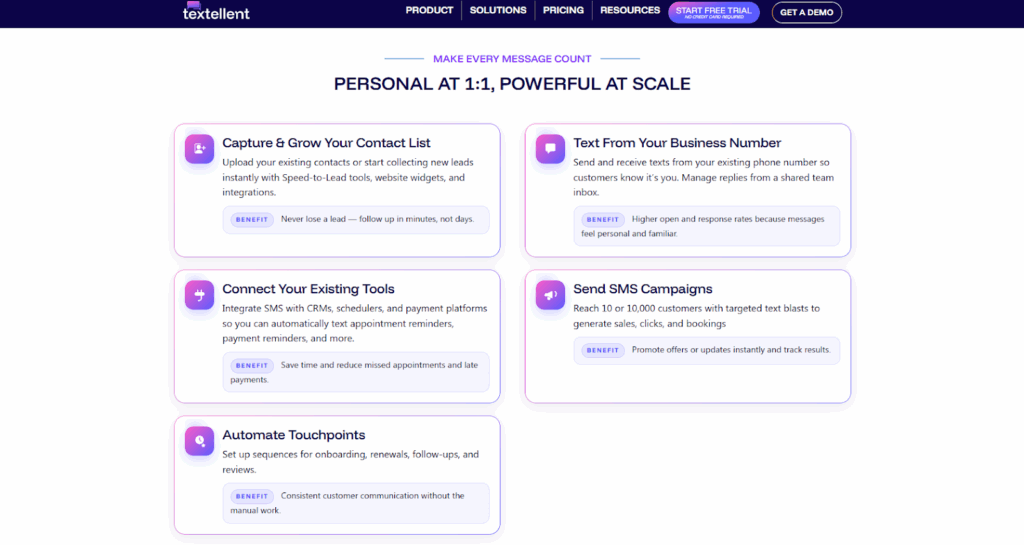
These capabilities are what make it the best SMS marketing tool for small businesses or large operations focused on results.
Automated Campaigns and Trigger-Based Messaging
Textellent lets you create automated text campaigns that run based on real-time customer actions or scheduled timelines.
Each automation can be tailored with delays, logic-based triggers, and branching paths to give you full control over how and when personalized text messages are delivered.
Two-Way Messaging With a Unified Inbox
Every conversation happens in a centralized inbox, designed for ease of use and visibility.
The user interface allows your team to see full conversation history, assign follow-ups, and manage real-time responses. Customers can reply to any text naturally, which makes it easier to handle customer inquiries.
Bulk SMS Without Losing Personalization
Textellent enables you to send bulk messages to large groups while still personalizing each one.
You can send announcements or seasonal promotions to thousands of contacts while maintaining a one-to-one feel through dynamic message fields.
Advanced Contact Segmentation and List Targeting
You can organize contacts into targeted segments based on behavior, activity history, purchase patterns, interests, or custom tags.
SMS segmentation makes it easy to send the message to the right group, whether you’re re-engaging dormant leads or tailoring campaigns to different service categories.
MMS Messaging and Rich Media Support
In addition to standard SMS, Textellent allows you to send MMS messages, ideal for marketing promotions, service updates, or anything that benefits from visual engagement.
Rich media boosts your brand presence and creates a more dynamic experience for the recipient.
Keyword Campaigns and Instant Lead Capture
Textellent supports keyword-driven campaigns that allow contacts to text a specific word (like “JOIN” or “OFFER”) to your number.
When someone texts in, their contact info is captured automatically and routed into a pre-built message sequence. This turns offline interest like signage, events, or ads into trackable leads.
Flexible CRM and App Integrations
Textellent connects SMS with more than 800 business tools, including CRMs, appointment scheduling systems, online forms, and payment platforms.
These integrations let you trigger automated messages based on events like new bookings or payment confirmations to ensure your SMS communication stays aligned with the rest of your workflow.
Browser-Based Messenger Extension
With the Textellent Messenger extension, you can send and receive messages without leaving the tools your team already uses.
This browser plugin brings templates, contact history, and reply functionality directly into your work environment, improving response time and minimizing task switching.
Mobile App With Real-Time Notifications
Textellent’s mobile app gives your team full access to one-on-one conversations on the go.
It includes real-time push notifications, smart reply templates, shared inbox visibility, and media support. No matter where you are, you can stay connected with customers and respond immediately.
Built-In Compliance and Consent Management
The platform includes robust tools for managing opt-ins, opt-outs, and message consent to help you stay aligned with the Telephone Consumer Protection Act (TCPA) and other compliance regulations.
Auto-handling of STOP requests, quiet hours, throttling, and message logging reduces legal risk and ensures proper communication boundaries are respected.
Analytics and Message Performance Reporting
Textellent provides detailed reports that track delivery success, reply rates, click-through performance, opt-outs, and campaign effectiveness.
These analytics help you fine-tune your messaging, identify what works, and optimize campaigns to increase conversions over time.
Support for Franchises and Multi-Location Businesses
If you manage multiple teams, locations, or franchises, Textellent gives you centralized control with localized execution through multi-location marketing.
Each branch can manage its own campaigns, while corporate teams maintain oversight and brand consistency. Performance data can be tracked by location to spot trends and optimize support.
AI-Powered Message Rewriting and Translation
Textellent helps refine message tone, adjust length, or rewrite content for clarity.
You can also translate texts into multiple languages for ease of communication with diverse audiences while maintaining professional messaging across the board.
Predictable and Business-Ready Pricing
Textellent offers tiered monthly plans that simplify SMS marketing strategy and scale with your business needs.
- The Essentials plan is $59 per month and includes 750 SMS credits, which you can use to send SMS or MMS messages.
- The Standard plan costs $119 per month and includes 2,000 SMS credits, with support for two users.
- The Premium plan has custom pricing with custom credits, unlimited lines, and unlimited users, tailored to enterprise usage.
All plans have a 15% discount when paid annually.
All three plans include free incoming texts, bulk SMS, MMS support, 10DLC carrier registration, and SMS API access.
If you go over your included credits, additional messages are charged at about 3.4–3.9¢ per additional credit in the Essentials and Standard tiers.
Textellent is the best SMS marketing software that combines one-to-one conversational texting with mass messaging capabilities to make customer communication more personal and efficient.
Sign up for a free trial or request a demo consultation today!
FAQs About Top SMS Marketing Platforms
Which SMS marketing platform is best for businesses of all sizes?
Among many different platforms for SMS marketing services available, Textellent stands out for its flexibility and depth. It combines two-way texting, automated workflows, bulk SMS, and rich integrations that are easy to navigate.
The powerful SMS marketing platform supports appointment reminders, nurture sequences, and SMS surveys within a framework designed for real business use.
Is SMS marketing legal in the U.S.?
Yes, but there are strict rules. U.S. businesses must follow TCPA and carrier regulations, which require prior written consent from SMS subscribers before sending SMS messages.
Each message also needs a way to unsubscribe, usually by including “Reply STOP to unsubscribe.” These legal requirements apply to all marketing channel types that involve texting, including campaigns sent through mobile apps or CRM tools.
What’s a good open rate or response rate for SMS?
Text message marketing consistently outperforms other channels when it comes to attention. Open rates are around 98%, and response rates hover around 45%.
That’s higher than email marketing or push notifications, which makes SMS ideal for bulk messaging, follow-ups, and time-sensitive campaigns.

Get Started with Business Texting
Simple to launch, built to scale. Try Textellent FREE for 14 Days
Start Free Trial