

5 Tax Season Tips For Business (Leveraging SMS and AI)
Tax season often feels like a race against time, with deadlines to meet, forms to collect, and financial decisions to make.
Many individuals and businesses find it overwhelming, but staying organized can make the process much easier.
One of the most effective ways to stay on top of everything is by using SMS marketing for quick client outreach.
Text messaging has grown beyond casual communication and is now a powerful tool for simplifying complex processes, including tax preparation.
In this article, we’ll share some tax season tips to make the preparation easier, more manageable, and less stressful for your clients.
TL;DR
- SMS makes tax season prep easier to manage by giving tax professionals a faster way to send reminders, updates, and client messages.
- A smoother tax season process starts with sending checklists, setting reminders, sharing deadlines and refund updates, keeping messages secure, and tailoring texts to each client’s needs.
- Early and organized tax prep matters because it lowers the risk of late filing penalties, missed refunds, and rushed errors that can affect filing accuracy.
- Better tax preparation can help clients maximize refunds, handle complex tax situations, stay updated on tax law changes, and improve financial planning.
- Textellent supports your tax strategy with automated texting, scheduled reminders, two-way SMS, multimedia messaging, and personalized outreach.
How SMS Can Simplify Tax Season Prep
As a tax preparer, incorporating SMS into client communication transforms how preparation is managed.
A text message reaches clients fast, keeps communication clear, and reduces the delays that come with phone calls or long email threads.
SMS fits into your tax season marketing strategy because nearly everyone has a mobile phone. This makes SMS a universally accessible tool.
Younger clients prefer texting over traditional communication methods and appreciate the convenience of SMS.
Meanwhile, older clients benefit from the simplicity of receiving updates without navigating complex email systems or going to the post office.
SMS also improves the overall client experience. Clients receive deadline reminders, refund or payment updates, and notices about tax law changes without needing a lengthy tax season email or phone call.
With automated texting software like Textellent, reminders can be tailored to clients’ needs so no one misses important filing dates. Book a demo now!
5 Tax Season Tips for a Stress-Free Preparation
Tax season is often a hectic time, both for tax professionals and clients. SMS can simplify how you communicate, organize, and speed up your processes.
Tip #1: Create a Tax Season Checklist
Your tax preparation checklist should cover all the documents and information necessary for accurate tax preparation. You have to tailor it to the needs of individual and business clients to maximize deductions.
Here’s a sample breakdown:
For individual filers
- W-2 forms from all employers
- 1099 forms for freelance or contract work
- Proof of tax-deductible expenses (e.g., medical bills, charitable contributions)
- Form 1098 for mortgage interest deductions and property taxes
- Student loan interest statements
- Last year’s tax return for reference
For business clients
- Profit and loss statements
- Payroll records
- Receipts for business expenses
- Form 1099-NEC for contractor payments
- Depreciation schedules for equipment
- Quarterly estimated tax payment records
Preparing for the tax season involves gathering numerous forms and paperwork. SMS can provide step-by-step checklists tailored to your tax-related documents.
Textellent makes it simple to send clients a concise list of required documents. Automated messages eliminate the back-and-forth communication required to clarify missing items and important documents.
Clients appreciate the simplicity and speed of receiving checklists via SMS. Instead of waiting for a call, they can reference a text message while gathering their documents.
Textellent also allows clients to respond directly with questions or send MMS messages of documents for added convenience.
Delight your clients and avoid penalties this tax season with two-way communication. Sign up for a free trial today!
Tip #2: Set Up SMS Reminders
Many clients struggle to keep track of multiple tax deadlines, such as filing dates, estimated payments, and document submission timelines.
SMS reminders are ideal for these situations because they deliver actionable information directly to their phone.
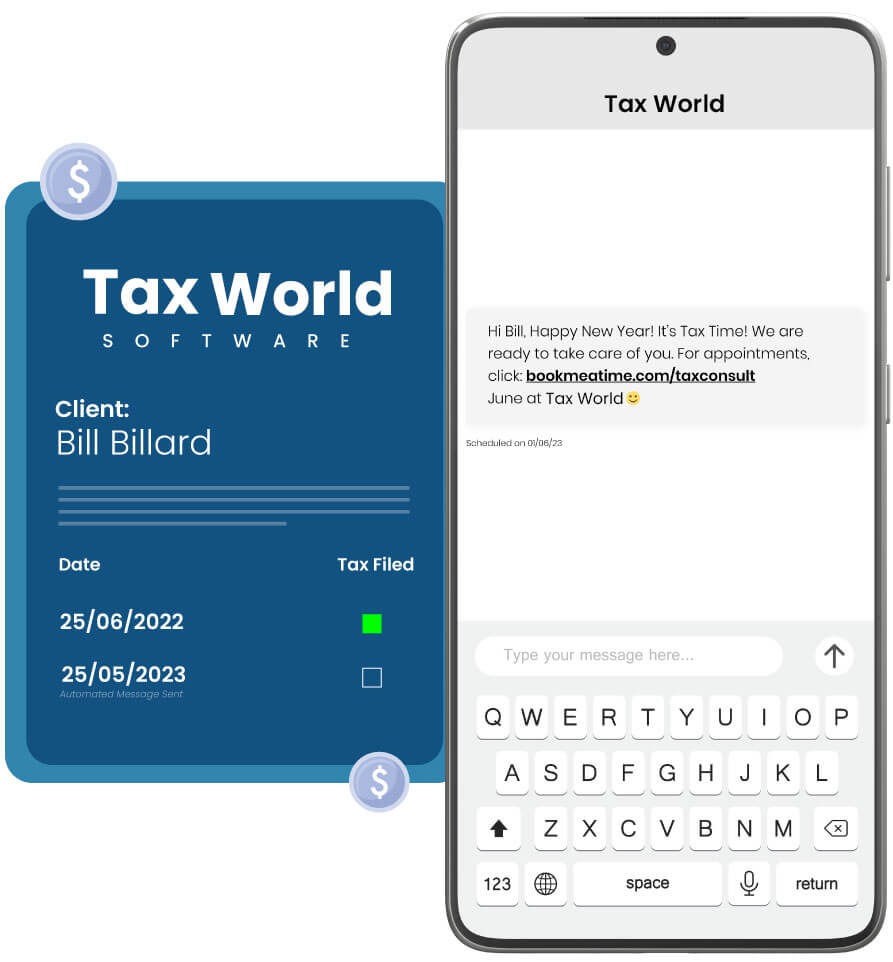
To get the most out of SMS reminders, start by tailoring messages to each client’s unique situation.
Unlike generic reminders, Textellent integrates with your tax software to personalize messages to match your tax and accounting marketing strategy.
The platform’s SMS scheduling capabilities also make this easier. You can schedule messages based on the client’s filing habits from the past year or specific deadlines.
Self-employed clients may receive messages about upcoming estimated payment deadlines. Individual filers could get reminders to submit documents or contributions to a traditional individual retirement account (IRA) before the tax year ends.
During tax season, you can’t always respond to every client’s inquiry immediately. Textellent’s SMS autoresponder guarantees that clients still feel acknowledged.
When a client sends a message after business hours, they receive an automated reply letting them know when to expect a response.
Tip #3: Share Deadlines, Tax Updates, and Refund Status
Tax season involves more than filing deadlines alone. Changes to deductions, credits, and filing requirements can also affect your clients’ returns.
SMS gives you a direct way to send timely updates about tax law changes and possible tax implications.
It also works well for personalized deadline reminders, whether a client needs to submit documents, make a payment, or complete another required step.
For self-employed individuals, quarterly estimated tax payments are another major deadline that can be managed through automated SMS reminders.
Messages can be scheduled in advance and tailored to each client’s filing situation, which makes follow-up easier to manage.
Once federal tax returns are filed, the refund waiting period can create uncertainty. SMS updates can notify clients when the IRS accepts a return or issues a refund.
Guidance about setting up an IRS online account can also complement your messages and reduce reliance on paper returns.
Tip #4: Use Secure SMS Platforms
When handling sensitive financial data, security is non-negotiable. Cybersecurity threats such as unauthorized access, phishing, and data breaches are real concerns when dealing with personal financial information.
A secure SMS platform like Textellent protects your client data while maintaining the convenience of text-based communication. It also reduces the risk of errors that could affect an accurate return.
Encryption makes sure that all messages and attachments are scrambled during transmission. Textellent complies with the Telephone Consumer Protection Act (TCPA) and adheres to the legal and ethical use of SMS communication.
Clients can be required to opt-in for SMS communication, which safeguards their privacy and meets regulatory requirements. If clients send sensitive data, confirm their identity through a separate verification step before proceeding with any actions.
Example use case: A client could securely send details about tax-free municipal bonds, deductions, or income statements through an encrypted SMS platform to keep information confidential.
Tip #5: Customize SMS for Client’s Needs
Your client list should be grouped by needs, such as small business owners, self-employed individuals, retirees, or families. That approach makes it easier to send messages tied to each client’s financial situation.
For example:
- A business owner could receive reminders about deducting qualifying equipment purchases and tracking qualified expenses
- A retiree might benefit from tips on maximizing a traditional IRA contribution
- Families could receive updates on claiming child-related credits or volunteer income tax assistance programs for additional support
- Clients who owe taxes could receive payment reminders before a deadline passes
You can show appreciation with personalized holiday or thank-you messages. These messages strengthen relationships and keep your services top of mind.

Textellent’s feature “Text Us Now” button can also be added to your website to make it easy for clients to reach out with questions or appointment requests.
Why Early and Organized Tax Prep Matters
Tax preparation is a task many tend to put off, but starting early and staying organized during tax filing season can make a huge difference.
Here’s why getting an early start and keeping tax documents in order is essential for individuals and businesses.
Avoid Late Filing Penalties
The Failure to File penalty is one of the most severe consequences of late filing after the tax filing deadline. The IRS charges 5% of the unpaid tax amount for each month or partial month that the return is late, with the penalty capped at a total of 25%.
If your client owes money at $2,000 and files four months late, the penalty could be $400. This adds up quickly, especially if they already face financial pressure during tax time.
Another common penalty is the Failure to Pay penalty, which is smaller but still impactful. It accrues at a rate of 0.5% of the unpaid taxes each month. If both penalties apply, the failure-to-file penalty is reduced to 4.5%.
It’s even more important to file on time, even if the client can’t pay the full tax bill. Interest on unpaid taxes compounds the tax burden, as the IRS charges interest from the filing deadline until the balance is paid.
Overdue filing also comes with hidden costs. Refunds from a federal income tax return must be claimed within three years, or they are forfeited.
Someone eligible for a $3,000 refund who forgets to file within the allowable period could lose that money forever and face a late payment penalty on unpaid balances.
Maximize Tax Refunds
Many taxpayers leave money on the table by overlooking deductions, credits, and other opportunities to lower their tax liability.
For the 2025 tax year, the standard deduction is $15,750 for single filers, $23,625 for heads of household, and $31,500 for married couples filing jointly.
The standard tax deductions simplify filing but may not yield the highest refund, especially if deductible expenses exceed those amounts.
Itemizing allows taxpayers to claim mortgage interest, state and local taxes (up to $40,000, or $20,000 if married filing separately, subject to income limits), medical expenses exceeding 7.5% of their adjusted gross income, and charitable contributions.
Tax credits are another powerful tool for boosting refunds, unlike deductions, which reduce taxable income; credits directly lower tax liability.
The Earned Income Tax Credit (EITC) can still add thousands of dollars to the client’s refund if they qualify, with the amount based on income, filing status, and the number of qualifying children.
Similarly, the Child Tax Credit provides up to $2,200 per qualifying child. At the same time, education-related credits like the American Opportunity Credit and the Lifetime Learning Credit can offset tuition costs and other education expenses.
The IRS typically processes early returns quickly, particularly if they’re filed through electronically filing methods and include direct deposit information to a bank account.
Reduce Stress and Errors
Waiting until the last minute often leads to rushed decisions and overlooked details. Clients are encouraged to begin gathering necessary documents. This includes W-2s, 1099s, and receipts for deductions as soon as the tax year ends.
Clients are advised to use a dedicated filing system and organize documents into categories to save time during filing and maintain accurate records.
Reviewing prior-year tax returns can also uncover unused tax deductions, credits, or carryover losses.
Using automated text reminders can further reduce stress. Notifications about upcoming deadlines or missing documents promote timely action and minimize the chances of last-minute rushes.
Handle Complex Tax Situations
Complex tax situations can arise from various circumstances, including owning a business, managing investments, or earning income from multiple sources. These situations often require additional preparation, knowledge, and documentation.
For clients managing investments, additional forms such as 1099-B or 8949 may be required to report capital gains or losses, dividends, and interest income.
They also have to handle payroll taxes, depreciation of assets, and deductions for operational costs tied to investment accounts.
Similarly, investors must report capital gains or losses, dividends, and interest income, which often require additional forms like 1099-B or 8949.
Clients with multiple sources, such as freelance work, employment, and rental properties, should also consolidate this information.
Stay Ahead of Changing Tax Laws
The Internal Revenue Service (IRS) publishes annual adjustments to tax brackets, deductions, and credits, which are often influenced by inflation and new legislation.
Small business owners and self-employed individuals face unique challenges when it comes to changing tax laws. Rules for business expense deductions, depreciation, and payroll taxes are subject to frequent updates.
Technology offers several tools to help track tax law changes. Subscribing to IRS newsletters or using professional tax tools that incorporate updates automatically can keep your clients informed.
Improve Financial Planning
If you review your client’s tax return, it provides valuable insights into their financial habits and opportunities for improvement.
Underperforming investments or areas where earnings can be diversified to help them make more informed decisions about their financial strategies.
Life events such as getting married, having a child, or buying a home can impact the tax situation.
Planning lets your clients become prepared to claim relevant deductions and credits, such as the Child Tax Credit or mortgage interest deduction.
Engage Clients Year-Round With Textellent’s SMS Solutions
Tax season is one of the busiest times of the year, and staying connected with clients is essential when filing taxes.
Textellent’s SMS solutions provide a practical way to expedite client interactions, send reminders, and keep everyone on track.
From rebooking missed appointments to updating clients on their filing progress, it guarantees your services are always accessible and easy to manage.
You can remind clients about your services through automated SMS campaigns, share helpful tax tips, or send a warm holiday message to stay on their radar. Consistent communication strengthens client relationships and encourages repeat business.
Features like self-scheduling tools and real-time updates ensure a smoother experience for both you and your clients, saving time and effort while improving satisfaction.
Provide a stress-free tax filing experience with Textellent’s unique business texting capabilities for tax and accounting professionals.

Sign up for a free trial or request a demo consultation with Textellent today!
FAQs About Tax Season Tips
How should I prepare for tax season?
It starts with organizing your financial documents and understanding your client’s filing obligations. You can use SMS to send timely reminders and checklists to your clients and encourage them to file electronically.
SMS platforms like Textellent can send personalized messages to help you gather what’s needed, such as W-2s, 1099s, deduction receipts, office supplies records, and health savings accounts statements.
Can I write off tips on taxes?
Tips are considered ordinary income, and they must be reported on federal tax returns. For clients working in hospitality or food service, reported tips should already appear on their W-2 forms provided by employers.
However, cash tips that weren’t reported must still be declared independently. A tax advisor or other qualified professional can review reporting questions, but only licensed professionals can provide legal advice.
How can I get a bigger tax return?
A larger refund starts with understanding which deductions and credits apply to your situation.
Making contributions to retirement accounts, tracking eligible work expenses, using the home office deduction when it applies, and reviewing a Roth IRA can all increase your refund.
A financial advisor can also review tax-smart savings decisions and identify planning gaps.
Is it better to claim 1 or 0 on your taxes?
The decision to claim 1 or 0 on the W-4 form depends on financial goals.
A claim of 1 reduces the amount of tax withheld from paychecks, which increases take-home pay but can result in a smaller refund.
A claim of 0 means more taxes are withheld, which can lead to a larger refund but less take-home pay throughout the year.
A conversation with a tax professional is always a smart step when deciding which option fits current needs and plans. Clients should also watch for tax scams when tax advice or filing requests arrive by text or email.

Get Started with Business Texting
Simple to launch, built to scale. Try Textellent FREE for 14 Days
Start Free Trial