

How AI for Text Messages Keeps Your Messaging Consistent
Consistency in messaging is one of the most overlooked challenges in a business setting.
When multiple team members are texting customers throughout the day, it’s easy for tone, clarity, and branding to slip. Over time, small gaps can weaken your brand voice and make your communication feel less trustworthy than it should.
Instead of relying on manually rewriting the same messages, you can use AI to stay on track by polishing messages, adjusting tone, and protecting the structure of key templates.
In this article, we’ll explore how AI for text messages helps solve the common problems that lead to inconsistent messaging. We’ll also introduce a texting software solution that keeps your communication easy to manage across your entire team.
TL;DR
- Business communication has shifted toward faster responses, which makes text messaging a primary channel for everyday interactions.
- AI helps you improve text messaging by refining tone, personalizing content, and supporting quicker, more consistent responses.
- Common use cases for texting AI include responding to leads, sending follow-ups, managing scheduling, supporting customers, and sharing internal updates.
- An effective AI texting workflow involves setting goals, mapping key conversations, creating refined templates, and setting up smart automation rules.
- Textellent offers a texting solution with AI-powered capabilities that help you rewrite, translate, and customize messages while keeping a consistent tone.
The Shift Toward AI-Powered Conversations in Businesses
The way businesses communicate has naturally shifted over time. People have grown used to getting information quickly, and long delays or missed messages can easily get in the way.
As work has become more complex and deadlines shorter, many companies are looking for ways to stay responsive without overcomplicating their processes. Email and phone calls still play a role, but they’re not always the most efficient option for everyday conversations.
Artificial intelligence has been helping businesses of all sizes manage conversations, respond faster, and reduce the time spent on repetitive tasks. One of the most effective ways this shows up is through SMS marketing.
AI now makes it possible to personalize texts and rewrite or translate them based on who’s receiving them. It can analyze inputs and adjust tone, format, or language to align with individual preferences, delivering the perfect message with greater speed.
Textellent makes this process simple by instantly polishing your texts and translating them into different languages, so every message stays on-brand and accessible across your audience.
If you’re thinking about how to bring that kind of simplicity and flexibility into your communication, Textellent offers a platform built to support smarter, faster texting.
Sign up for a free trial or request a demo consultation today!
How Businesses Use AI for Text Messages
Text messaging now stands as a central tool for enterprise communication. You can have more conversations at once without losing the personal touch that customers expect.
Here are some of the top ways businesses are putting AI for text messages to work:
Respond to New Leads
First impressions matter. When a new lead reaches out, you can share helpful information, ask a quick question, or guide them to the next step.
Using AI-generated texts makes sure the response is aligned with your consistent brand voice, even if different team members are handling outreach.
Follow Up Consistently
Staying on top of follow-ups is easy with automated texts. If you’re reconnecting with a lead or reminding someone about an upcoming appointment, scheduled messages go out on time.
Help Customers Get Answers Faster
Customers often ask the same basic questions, such as business hours, location, or how to reschedule. AI can handle these routine replies.
When something needs a human touch, the system can flag it for follow-up for a smoother customer experience overall.
Simplify Scheduling
Booking and rescheduling appointments can be effortless when you use text messaging.
AI can confirm times, send reminders, or suggest alternative options, all based on how someone replies. This works well in settings where schedules change often or where clients need flexibility.
Reach People in Their Preferred Language
Language matters when you want to build trust. AI tools now make it possible to send messages in someone’s preferred language automatically.
This allows you to connect with a broader audience, especially if your community is multilingual and communication is part of daily operations.
Create Marketing Campaigns
Not every customer wants the same message at the same time.
With AI, you can adjust when to send marketing messages and what to send based on how people have interacted with previous messages. It turns routine outreach into a more thoughtful and better aligned with each contact’s interests.
Keep Everyone on the Team Informed
Text messaging is just as useful inside your business as it is with customers.
Many teams use it to share shift changes, meeting reminders, or important updates. AI helps keep those messages timely and ensures the right information gets to the target people.
How to Build Your AI Texting Workflow
Getting started with AI-powered text messaging can feel like a big leap, but breaking it down into steps makes the process manageable.
With the help of natural language processing (NLP) and generative AI, you can create more consistent, personalized conversations that save time and boost engagement.
Here’s how you can put together a workflow that fits your business needs and keeps your conversations running.
1. Set Clear Goals for Your Messaging
Start by defining what success looks like. Do you want to reduce response times, improve message replies, or increase customer loyalty?
Having that in mind will help you decide what kind of messages to send, when to send them, and how to measure if they’re working.
For example, you might use it to answer customer inquiries, send appointment reminders, or follow up after a sale. Each goal may require a different workflow, so outlining your priorities upfront gives you the right structure to build on.
2. Choose the Right SMS Platform
Once your goals are set, choose an SMS marketing platform that supports your business needs and integrates well with your existing systems.
The right AI tool should make it easy to send SMS messages, manage customer contacts, and automate customer communication.
Textellent has a built-in AI Rewriter & Translator tool that lets you improve grammar, tone, and flow while keeping your original message intact.
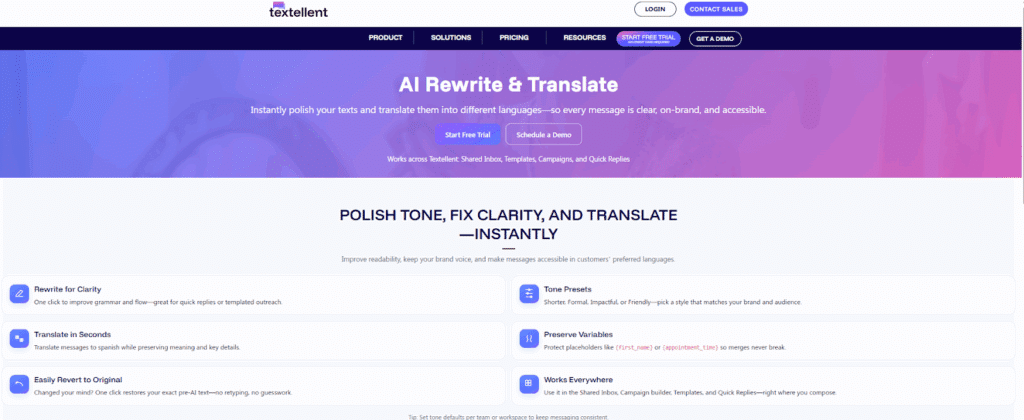
If you’re sending a quick reply or building out a campaign, you can adjust the tone to match your audience with presets like Friendly, Formal, Shorter, or Impactful.
If you’re communicating with a diverse audience, you can also instantly translate messages into Spanish while preserving context and important details.
Also, you don’t have to go searching for these tools. They’re available right where you’re already working, whether that’s inside templates, the campaign builder, or your shared inbox.
Sign up for a free trial or request a demo consultation with Textellent today and experience the power of AI for text messages!
3. Map Out Common Conversations
Start with the moments that happen often, such as welcoming a new lead, confirming an appointment, answering a quick question, or following up after a service. These recurring touchpoints are great places to start adding structure and automation.
Think about the flow of each interaction. What’s the first message someone receives? What kind of reply are you expecting? What should happen if they don’t respond?
You don’t need to script every word, but having a clear sense of the key messages and timing helps keep things consistent. This also makes it easier to spot where AI tools can step in.
4. Create and Refine Your Message Templates
Your templates should be easy to read and feel like a natural part of the conversation, not overly formal or too casual unless that fits your brand.
You can add personalization where it matters, such as using a customer’s name or referencing a specific time or service.
When working with message templates that use dynamic fields such as {first_name} or {appointment_time}, those placeholders should stay intact. Textellent automatically protects these variables during edits or rewrites, so your merges always work as expected.
Textellent’s AI Rewriter lets you adjust the tone of your message with built-in style options and improves readability. And if you ever want to undo a change, it takes one click to easily restore your original version.
5. Set Up Triggers and Automation Rules
It’s essential to identify the key actions or timeframes that should prompt a message. This could be when someone books an appointment, completes a form, replies to a text, or hasn’t responded within a certain number of days.
A follow-up sent too soon can feel pushy, while one that’s delayed might lose the opportunity altogether. You can use Textellent’s SMS scheduling feature to set delays, time-of-day limits, or wait periods between messages to match how your audience prefers to engage.
6. Test Your Workflow
Before putting your texting workflow into action, take time to test it from start to finish. This step helps you catch any issues with timing, message content, or trigger logic before real customers are involved.
If you’ve used features like AI rewriting or translation, you have to double-check that the final version still delivers your message clearly. Make sure any variables, like names or appointment times, show up as expected, and nothing feels out of place.
Stay Polished Even in High-Volume Conversations—Try Textellent!
As conversations grow, it becomes harder to keep every message on-brand. With AI-powered tools designed for real-world business texting, Textellent helps you improve your campaigns before they’re sent.
You can instantly rewrite content for better clarity, apply the right tone for each audience, and translate messages while keeping key details intact.
Sign up for a free trial or request a demo consultation with Textellent and see how AI for text messages can boost your customer outreach and response rates!
FAQs About AI for Text Messages
Is there an AI that helps with texting?
Many SMS platforms now include AI tools that assist with writing, editing, and managing conversations.
Textellent offers features that help you polish your messages, keep them on-brand, and respond faster in just a few clicks. These tools are helpful when you’re handling high volumes of communication and want to maintain consistency.
How to use AI in text messages?
AI models are typically used to simplify and improve your text communication by supporting features like text generation, message refinement, tone adjustment, and auto-responses.
Some platforms also use AI chatbots to manage real-time conversations, answering common questions based on past data and customer interactions.
Is there an AI that will write text for you?
Yes. Many SMS platforms like Textellent include AI-generated writing tools that help you create responses quickly.
These AI-generator tools use your inputs and contact behavior to generate messaging that feels natural and tailored to your audience without requiring you to start from scratch.
Is there a free AI text message generator?
Free AI text generators are available, but they lack business-grade control, security, and integration. Most don’t offer features that align with professional needs like syncing across your app, managing content across social media or your website, or protecting sensitive data.
For business use, especially when accuracy, brand consistency, and message timing matter, using a dedicated SMS marketing platform offers more reliability.

Get Started with Business Texting
Simple to launch, built to scale. Try Textellent FREE for 14 Days
Start Free Trial